The Graham formula estimates a stock's intrinsic value as earnings per share times the sum of 8.5 and twice the expected growth rate. A later revision scales the result by the ratio of 4.4 to the prevailing high-grade bond yield. A separate construct, the Graham Number, sets a maximum defensive price as the square root of 22.5 times earnings per share times book value per share. Both assume stable, positive earnings, and neither contains a margin of safety of its own. Treat either as a fast sanity check on a profitable, moderate-growth business, not as a valuation engine for high-growth, cyclical, or asset-light companies.
What the Graham formula actually calculates
The Graham formula first appeared in the 1962 edition of Security Analysis and was carried into the 1973 revision of The Intelligent Investor. Graham's own footnote warned that it modeled the results of other growth formulas and was not a valuation method in its own right. It estimates the intrinsic value of a share from two inputs: current earnings and an expected growth rate. In its original form it reads as follows.
V = EPS × (8.5 + 2g)
Here V is the intrinsic value per share, and EPS is normalized trailing earnings per share. The term g is the expected annual earnings growth rate over the next seven to ten years. Enter g as a whole number: a 10 percent rate is written as 10, not 0.10. The 8.5 is the price-to-earnings ratio Graham assigned to a company with no expected growth, a reasonable anchor for a stable but static business. The 2g term lifts that multiple as growth expectations rise.
The appeal is obvious. Where a discounted cash flow model asks for a multi-year cash-flow forecast, a discount rate, and a terminal value, the formula asks for one earnings figure and one growth number. Aswath Damodaran's lecture notes on price-earnings ratios show why a simple earnings multiple can capture a great deal about a business. The Graham formula is essentially a rule for setting that multiple from a growth assumption. What the formula is not is a substitute for a full discounted cash flow or a purchase price. It produces a rough fair value. Graham presented it as an illustration of how growth maps to a multiple, not a mechanical valuation engine to be trusted blindly.
The 1974 revision: correcting for interest rates
Graham later recognized that a fixed set of constants could not hold across every interest-rate environment. The fair value of a stream of earnings depends on the return available from safe alternatives. In the early 1960s, high-grade corporate bonds yielded far less than they would a decade later. In a 1974 revision of the formula he scaled it by the ratio of a reference bond yield to the current one.
V = [EPS × (8.5 + 2g) × 4.4] / Y
The 4.4 is the average yield on high-grade (AAA) corporate bonds in the early 1960s, when Graham set the original constants. Y is the current yield on AAA corporate bonds, which today can be read directly from the Moody's Seasoned Aaa Corporate Bond Yield series published by the Federal Reserve. The logic is sound in principle: when safe bonds yield more, a given stream of earnings is worth less. The multiplier 4.4 divided by Y then falls below one and pulls the value down. When bond yields are low, the multiplier rises above one and lifts the value.
Figure 1. How the interest-rate multiplier reshapes the value
The 1974 revision multiplies the original value by 4.4 divided by the current AAA bond yield, so the same earnings and growth produce very different values as rates move.
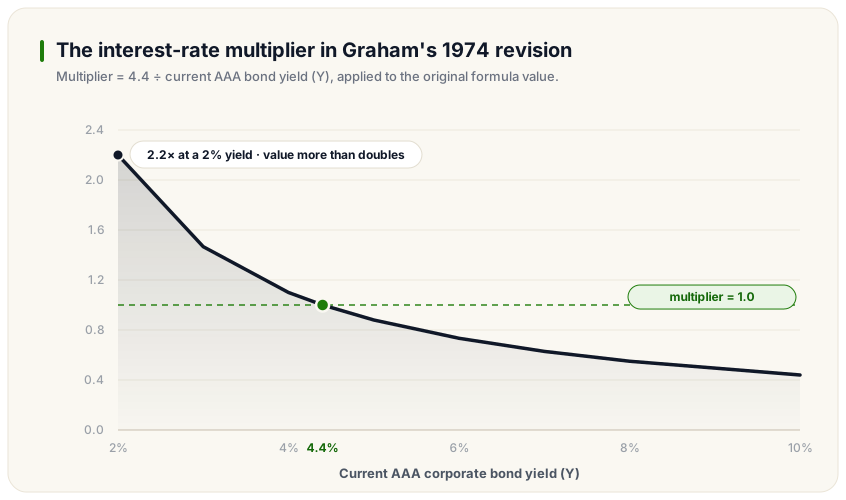
The revision fixes one problem and introduces another. Because the multiplier is a simple reciprocal of the bond yield, it swings hard at low rates. At a 2 percent AAA yield the multiplier is 2.2, more than doubling the value the original constants produced. That sensitivity means the revised formula can hand back an aggressive number in a low-rate world precisely when investors most need discipline. The correction is worth understanding, but the output still has to be read as an estimate wrapped in wide error bars. Treating it as precise to two decimal places misreads what it is.
The Graham Number: a separate ceiling from earnings and book value
A second construct circulates under Graham's name, and it is not the growth formula at all. The Graham Number sets a maximum price a defensive investor should pay, drawing on earnings and book value rather than earnings and growth.
Graham Number = √(22.5 × EPS × BVPS)
BVPS is book value per share. The 22.5 is the product of two ceilings from Graham's criteria for the defensive investor: a maximum price-to-earnings ratio of 15 and a maximum price-to-book ratio of 1.5. Fifteen times 1.5 is 22.5. The square root brings the result back to a per-share figure. The number that comes out is not an estimate of fair value in the sense the growth formula tries to produce. It is a ceiling, the most a conservative investor should pay given current earnings and the assets on the balance sheet.
The distinction matters because the two tools reward opposite things. The growth formula pays a company for expected growth and ignores the balance sheet. The Graham Number ignores growth entirely and leans on book value, which anchors it to tangible assets. For a stable industrial with real plant and equipment the Graham Number is a useful discipline. For an asset-light business whose worth sits in brands, software, or network effects that never reach the balance sheet, book value understates the company. The Graham Number then reads far too low. The two constructs answer different questions: what a growing business is worth, and how much assets and current earnings justify paying. Knowing which one you are asking is the difference between using the right tool and quoting a meaningless number.
A worked example: both formulas on one company
Numbers make the gap concrete. Take a stable, profitable business. Its normalized earnings per share are 5.00 dollars, book value per share 40.00 dollars, and expected growth a defensible 5 percent. Assume the current AAA corporate bond yield is 5.5 percent. Pull that figure fresh from the Federal Reserve series rather than reusing this example's number.
The original growth formula gives a fair value of 5.00 times the sum of 8.5 and 10, which is 5.00 times 18.5, or 92.50 dollars per share. Applying the 1974 interest-rate revision multiplies that by 4.4 divided by 5.5, a multiplier of 0.8, bringing the value to 74.00 dollars. The Graham Number is the square root of 22.5 times 5.00 times 40.00, which is the square root of 4,500, or about 67.08 dollars.
Three defensible calculations, three different numbers, spanning 67.08 to 92.50 dollars. That spread is the honest output. Averaging it into a single number hides the uncertainty that matters. The growth formula sits at the top because it rewards the 5 percent growth assumption. The Graham Number sits at the bottom because it caps the price at what earnings and book value support. None of the three is a purchase price. Graham built the margin of safety as a separate discipline for exactly this reason. The fair value estimate is where the analysis starts; the discount you demand below it is where capital is protected. Deciding which valuation method to use in the first place determines whether the Graham formula even belongs in the toolkit for a given company.
Where the Graham formula breaks
The most useful thing to know about any valuation tool is where it fails, and Graham's two tools fail in five recognizable ways.
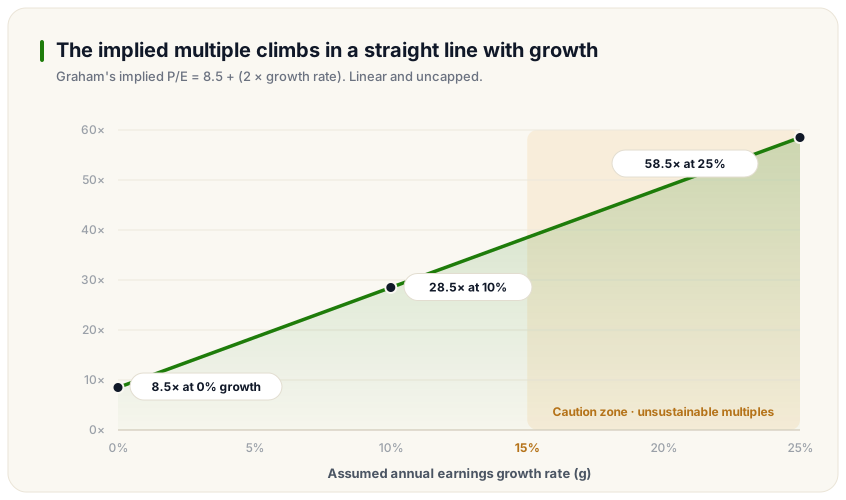
The first is growth sensitivity. The 2g term is linear and uncapped, so the implied multiple rises in a straight line as the growth assumption climbs. It reaches 8.5 times earnings at zero growth, 28.5 times at 10 percent, and 48.5 times at 20 percent. No market pays a linearly rising multiple for ever-higher growth, and no business sustains a high rate indefinitely, so an aggressive growth input produces a value untethered from reality. In practice, some analysts cap the growth input or use a smaller growth coefficient to tame this, though both depart from Graham's original.
Figure 2. The implied multiple climbs in a straight line with growth
The original formula's earnings multiple, 8.5 plus twice the growth rate, rises without limit as the growth assumption increases, which is the source of its overvaluation of high-growth names.
The second is the interest-rate distortion covered above: the 4.4 divided by Y multiplier swings the value sharply when bond yields are very low or very high. The third is the balance-sheet blind spot in the Graham Number. It understates asset-light businesses whose value never appears in book value, and it can overstate companies carrying inflated or stale book assets. The fourth is the requirement for stable, positive earnings. A company with negative earnings makes the growth formula meaningless and leaves the Graham Number undefined, the square root of a negative number. A deeply cyclical business reporting peak earnings produces an authoritative-looking value built on a number the cycle will erase. Normalizing earnings across a full cycle, using the primary filings on SEC EDGAR rather than a single trailing figure, is the minimum defense.
The fifth is the one investors forget most often. The formula returns a fair value or a ceiling, never a buy price. It contains no margin of safety, so treating its output as a green light skips the entire step where a disciplined investor demands a discount to absorb being wrong. What a stable business might be worth and what you should pay for it are two separate questions, and the formula answers only the first.
How to apply this
Use the Graham formula for what it is: a fast, transparent first pass on a stable, profitable, moderate-growth company, and nothing more. Normalize earnings before you enter them, then run both the growth formula and the Graham Number to bracket a rough range. Treat the spread between them as information about how much the answer depends on growth versus assets. Cross-check the result against a discounted cash flow whenever the verdict matters, because the DCF forces the growth and discount-rate assumptions the shorthand hides into the open. The InvestViable Valuator builds that cross-check from three explicit inputs: the cash flow growth path, the discount rate, and the terminal growth rate. Every assumption stays user-controlled and visible. On each stock page, the Graham-inspired earnings method appears as Earnings Fair Value beside the DCF and EBITDA Multiple estimates, so the formula never stands alone. To start from a coherent set of candidates, the InvestViable stock screener filters the US universe on fundamentals and the Investment Score. A Stock Universe slice such as value stocks narrows the field to the profitable, reasonably priced companies the formula was built to evaluate. Then apply a margin of safety scaled to the uncertainty of the business. The number the formula gives you is where the work begins, not where it ends.
InvestViable does not publish buy or sell recommendations on individual securities. All analysis is based on public financial data and a transparent methodology. The Investment Score formula is proprietary; the inputs and what the score evaluates are documented.