
InvestViable does not publish buy or sell recommendations on individual securities. All analysis is based on public financial data and a transparent, documented methodology. The Investment Score formula is proprietary; the inputs and what the score evaluates are documented. The Apple example below is a methodology walkthrough, not a directional view on the stock.
Introduction
Margin of safety is the most-quoted phrase in value investing and the least-operationalized. Every introduction to the discipline names it as a core principle. Almost none of those introductions specify a number. The result is a generation of retail investors who can quote Graham fluently and have no operational rule to apply when they sit down to look at a stock.
Margin of safety is the discount between an investor's estimate of a stock's intrinsic value and the price they are willing to pay. The principle, formalized by Benjamin Graham in his 1949 book The Intelligent Investor, exists to absorb the modeling errors every valuation contains.
The failure mode is consistent. An investor reads The Intelligent Investor, internalizes the idea that purchases must happen at a discount to intrinsic value, runs a discounted cash flow model, gets a number, and then buys somewhere near that number. The principle was respected in theory and ignored in practice. The discount that was supposed to absorb modeling error never materialized, because no specific threshold was ever set in advance.
The fix is unglamorous. Specify the percentage in advance, by business type, before evaluating any specific stock. The discipline lives in the prior commitment. The rest of this article shows what that looks like operationally: what the threshold should be for different kinds of businesses, why the threshold varies, and what specifically goes wrong when investors apply a single number to every situation.
Graham wrote that the function of margin of safety is "to render unnecessary an accurate estimate of the future." The investor who gets the number right does not need the discount. The investor who is honest about getting the number wrong does, and the wider the band of plausible error, the wider the discount has to be. Benjamin Graham, The Intelligent Investor, Chapter 20
What is margin of safety in investing?
Margin of safety is the discount between an investor's estimate of a stock's intrinsic value and the price they are willing to pay. Formalized by Benjamin Graham in 1949, it exists because every valuation contains errors in inputs, assumptions, and judgment. A wide enough discount lets the investor be wrong on the model and still preserve capital.
The operational question is not whether to apply margin of safety, but how wide the discount needs to be for a given business. A 30% threshold is a useful starting point for moderately predictable businesses. Predictable cash-flow businesses warrant smaller discounts (10–20%). Cyclical businesses warrant larger ones (35–50%). The threshold must be specified in advance, before any specific stock is analyzed.
Most textbook treatments of margin of safety stop at this conceptual answer. The work that actually changes investment outcomes begins with translating the concept into a percentage discipline calibrated to the forecast reliability of the underlying business.
Graham's own numbers, not just the slogan
The percentage discipline is not a modern overlay on Graham's idea. Graham operationalized margin of safety with explicit numbers, and recovering that rigor is the point. In Security Analysis (1934), the net-net rule caps the purchase price at two-thirds of net current asset value, defined as current assets minus all liabilities, with fixed assets counted at zero. The one-third haircut is itself a margin of safety: it assumes receivables and inventory recover materially less than book value in a wind-down, and it sizes the discount to that assumption rather than to sentiment.
In The Intelligent Investor (1949), the stock-selection criteria for the defensive investor are equally numeric: an earnings yield at least twice the yield on a high-grade corporate bond, a price below 15 times three-year average earnings, and a price below 1.5 times book value. Each threshold is a quantified buffer against paying for optimism. Graham never left the discount to in-the-moment judgment; he fixed it in advance as a number, which is the discipline the bands in this article restore for the far larger set of businesses his net-net screen would never surface.
Why the threshold has to vary by business type
The biggest operational error in retail margin-of-safety practice is treating one number, usually Graham's 30%, as the threshold for every business. The threshold should not be uniform because forecast reliability is not uniform. A regulated utility's earnings can be modeled a decade out and rarely be off by more than 10–15%. A cyclical industrial's earnings can swing 60% peak to trough, and the analyst who models it as if it were predictable is producing fiction with a number on it.
The margin of safety adjusts for the width of the forecast band. It does not adjust for the popularity of the stock, the conviction of the analyst, or the recent performance of the model. A high-conviction call with a wide forecast band still requires the wide discount. Conviction does not narrow uncertainty.
Margin-of-safety bands by business type
Indicative percentage discounts disciplined value investors apply, anchored to forecast reliability
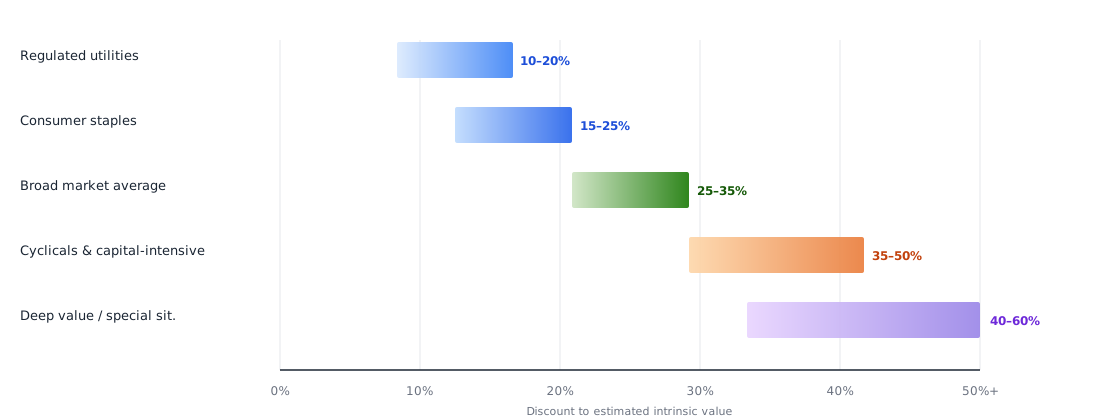
What is the margin of safety threshold for different business types?
The table below summarizes the operational thresholds and the rationale for each. Each row is a self-contained reference: business type, suggested margin range, the forecast reliability that justifies it, and the most common modeling errors the discount has to absorb.
| Business type | Margin range | Forecast reliability | Primary errors absorbed |
|---|---|---|---|
| Regulated utilities | 10–20% | High. Rate-base earnings, mandated returns, predictable a decade out within ±15% | Rate-case timing, fuel cost pass-through delays, regulatory rule changes |
| Consumer staples | 15–25% | High. Inelastic demand, brand pricing power, recurring revenue | Input cost inflation, FX translation, slow-burning category disruption |
| Broad market average | 25–35% | Moderate. Typical diversified business without unusual cyclicality | General modeling error in growth, margin, and discount rate assumptions |
| Cyclicals & capital-intensive | 35–50% | Low. Earnings can swing 60% peak to trough through the cycle | Cycle-position estimate, normalized earnings level, capex timing |
| Deep value / special situations | 40–60% | Very low. Going-concern uncertainty, distressed balance sheets | Solvency outcome, restructuring path, asset realizability |
Regulated utilities: why 10–20% is enough
A regulated utility operating under a defined rate base earns a regulator-approved return on capital. Cash flows stay predictable to within a narrow band over a decade because the regulator caps the upside and effectively floors the downside. Forecast errors in this category usually concern timing (rate cases delayed, fuel cost pass-throughs slow) rather than the magnitude of the underlying business. A 15% discount tends to absorb the realistic modeling error band. Wider discounts in this category usually mean the investor is over-modeling the risk and forfeiting opportunities the discipline did not require them to forfeit.
Consumer staples: 15–25% reflects inelastic demand
Demand for consumer staples stays largely inelastic across the economic cycle, and brand strength provides a margin moat that protects pricing during downturns. Forecast errors come from input cost inflation, FX translation in multinational businesses, and slow-burning category disruption such as private-label substitution, demographic shifts, or channel changes. A 20% discount is a reasonable operational starting point for high-quality global staples. The discount widens to 25% for mid-tier brands or geographies with weaker pricing power.
Broad market average: the canonical 30%
This is the band most retail conversations about margin of safety implicitly default to. Buffett's frequent reference to wanting "a margin of safety" without specifying a percentage is generally read in this band. A 30% discount on an honest intrinsic-value estimate of an average diversified business is the canonical Graham number for a reason: it absorbs the typical width of modeling error for businesses without unusual cyclicality or balance sheet stress.
Cyclicals and capital-intensive: 35–50%
Steel, chemicals, autos, semiconductor capital equipment, shipping. Earnings power oscillates through the cycle and the question of "what is normalized earnings" is itself an estimate with a wide band. The discount has to absorb both the level of normalized earnings and the timing of the cycle. Howard Marks's framing in the Oaktree memo "You Can't Predict. You Can Prepare." applies. The investor's job is to specify what cycle position they are paying for, and the discount is what protects against being wrong on cycle position.
Deep value and special situations: 40–60%
Distressed balance sheets, post-bankruptcy reorganizations, businesses where the question "is this a going concern" is itself part of the analysis. The wider the going-concern uncertainty, the wider the discount needs to be. Not because the analyst is more conservative, but because the band of plausible outcomes is genuinely wider. Mohnish Pabrai's framing in The Dhandho Investor (2007), "heads I win, tails I don't lose much," is operationalized here. The discount is the size of the protection against the tails case. It has to be wide enough that the bear-case fair value, after the discount, is still a price at which the investor can absorb being wrong.
A worked example: applying the bands to a single name
To make the rule concrete, here is a methodology walkthrough using Apple Inc. Its 10-K filings on SEC EDGAR are public and its segment disclosures detailed, and its business blends a consumer staple (recurring Services revenue) with a cyclical (hardware refresh patterns). Methodology only. This is not a directional read on the security.
Step 1. Classify the business by segment, not by label. Apple is often shorthanded as a "consumer technology" business, but its operational margin band cannot be set from that label. Apple discloses revenue across two top-level segments in its 10-K: Products (iPhone, Mac, iPad, Wearables/Home/Accessories) and Services (App Store, advertising, AppleCare, payment services, cloud). Each has different forecast reliability, and the operational margin band is the weighted result, not a guess at the company level.
| Segment | Illustrative weight | Forecast reliability | Implied band |
|---|---|---|---|
| iPhone (within Products) | ~50% | Moderate. Refresh cycles and ASP elasticity create a wider forecast band than a true staple, narrower than a full cyclical. | 25–30% |
| Mac, iPad, Wearables (within Products) | ~25% | Moderate-to-low. Smaller, more cyclical hardware lines with greater unit-volume sensitivity to macro conditions. | 28–35% |
| Services | ~25% | High. Recurring revenue, contractual or ecosystem-locked, behaves closer to a consumer staple. | 15–22% |
Weights are illustrative, based on the rough revenue mix in Apple's recent 10-K segment disclosures; pull current figures rather than reuse these. The point is the structure of the calculation, not these specific numbers.
Weighted, the operational margin band lands at roughly 23–29%: wider than the Services-only band because Products dominates, narrower than a full hardware cyclical because Services anchors the lower end. This is the threshold the analyst commits to before any valuation work begins. If a future fiscal year shifts the mix materially, the band gets re-derived. The number is not a guess; it is a weighted output of segment-level forecast reliability.
Step 2. Build the intrinsic value range. Bear, base, and bull free-cash-flow scenarios for each segment separately, then summed. Sourced from publicly disclosed numbers in the most recent 10-K and 10-Q. The fair value range is the bear-case to bull-case span, not a single number.
Step 3. Apply the discount to the bear case, not the base case. This is the step retail investors most commonly skip. The margin of safety gets applied to the bear-case fair value, which is the value that has to hold for capital to be preserved if the modeling assumptions are wrong. Applying it to the base case effectively halves the protection, because the base case has to be correct for the cushion to function.
Step 4. Translate to a maximum purchase price. Apply the 23–29% band from Step 1 against the bear-case fair value the model produces. The result is a maximum acceptable purchase price the investor either transacts below or does not act on. The threshold was set by segment classification, not by the current quote.
The output is not a buy signal. It is a maximum-acceptable-price boundary, set independently of where the market is quoting, and the market may never offer a price below it. The discipline is in defining the boundary correctly, not in forcing a transaction. For the live segment data and 10-K disclosures used in this kind of calibration, see the Apple (AAPL) stock page on Invest Viable.
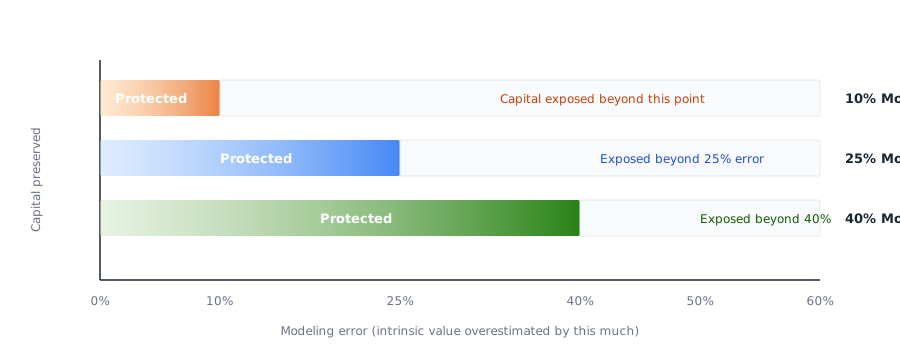
How three margin levels withstand modeling errors of different severity
A 10% margin only protects against small errors. A 40% margin absorbs severe ones. The right discount matches the realistic error band of the business.
The four ways the discipline breaks in practice
Knowing the rule and applying it are different problems. Across observed retail value-investing workflows, the same four failures recur:
- Setting the threshold after looking at the price. If the investor's "required" discount conveniently happens to be slightly less than the current quoted gap, the threshold was not set. It was discovered. The discipline requires the threshold to predate the analysis of any specific stock, written down in a checklist, before the ticker is ever opened.
- Applying the discount to the base case rather than the bear case. The bear case is what has to hold for capital to be preserved. Applying the margin to the base case means the protection only exists if the base case is right, which is the opposite of what the principle was designed to provide. This is the most frequent operational error among retail investors who follow the methodology in form but not in substance.
- Treating one number as the threshold for every business. The 30% Graham number is a useful default for the average business. Applied to a regulated utility it is too wide and produces non-participation. Applied to a deep-value distressed name it is too narrow and produces real losses. The threshold has to scale with forecast reliability.
- Widening the threshold under stress to justify inaction. When markets are expensive, investors widen their required margin to "stay disciplined." This sounds rigorous and is often the opposite of discipline. It is moving the goalposts to justify inaction. The threshold should be set by business characteristics, not market mood.
Charlie Munger's standing observation that "the trick is, when there's nothing to do, do nothing" applies here, but only after the threshold is set correctly. The investor who never transacts because their threshold is wider than any market has ever offered is not patient. They are unable to participate. Reflective of Munger's repeated guidance at Berkshire Hathaway annual meetings
How does margin of safety relate to fair value and intrinsic value?
Margin of safety does not stand alone. It is one component of a complete valuation discipline that includes intrinsic value estimation, fair value range construction, and forecast reliability assessment. The terms get used interchangeably in retail content. They are not interchangeable.
The discounted present value of all future cash flows the business will produce for its owners. A theoretical concept that requires assumptions about growth, margins, and discount rate. The assumptions are where the modeling error enters.
A bear-case to bull-case band of plausible intrinsic values, reflecting the reasonable spread of assumptions. The bear-case end of the range is the value at which capital must remain preserved if the bear case becomes reality.
The historical accuracy with which a business's cash flows can be projected. Higher for predictable businesses such as utilities and staples. Lower for cyclicals and special situations. Drives the width of the fair value range and the size of the required margin of safety.
The relationship is sequential. First, the analyst estimates intrinsic value across reasonable assumptions to build a fair value range. Second, the analyst assesses forecast reliability to determine how wide the band of error genuinely is. Third, the analyst applies a margin of safety threshold calibrated to that reliability, against the bear-case end of the range, to produce a maximum acceptable purchase price. Each step depends on the previous one being honest. Skipping forecast reliability assessment, which is the typical retail shortcut, collapses the entire chain.
Margin of safety in the price versus in the business
Graham located the entire margin of safety in the price: buy any business cheaply enough and the discount does the protecting. Buffett, under Munger's influence, added a second source. A durable competitive advantage narrows the forecast band itself, so a high-quality business carries part of its margin of safety in the predictability of its cash flows, not only in the discount to intrinsic value. This is the reasoning behind preferring a wonderful business at a fair price over a fair business at a wonderful price, set out across the Berkshire Hathaway shareholder letters.
Quality and price are not substitutes for the discount, though. It still belongs after the valuation, applied to the bear case, not baked into the inputs. Loading the same risk into both an inflated discount rate and the margin double-counts it. Where forecast risk and capital-market risk each belong is set out in the discount rate guide; the mechanics the discount sits on top of are in the DCF valuation guide.
For methodology adjacent to this, including building the fair value range the discount is applied against, see Valuation Ranges and Fundamental Analysis Frameworks and Stock Market Price vs Value. For the question of how to translate the maximum-acceptable-price boundary into an actual entry decision under live market conditions, see Stock Market Valuation: A Framework for Probabilistic Analysis.
How to apply this
The shape of an operational margin-of-safety discipline, condensed:
- Define your threshold bands by business type. Use the table above as a starting reference and adjust based on your own forecast reliability. If you are systematically wrong on a particular industry, widen the band for that industry. Write the bands down before you analyze any specific stock.
- Build a fair value range, not a single number. Bear, base, and bull cases anchored to the most recent primary-source filings (10-K, 10-Q, annual reports). The width of the range is the width of your honest assumption uncertainty.
- Apply the discount to the bear case. The maximum acceptable purchase price is the bear-case fair value reduced by the threshold for that business type. This is the boundary the market either offers or does not.
- Hold the boundary or do not transact. If the market never offers a price below the boundary, you do not own the stock. That is a feature of the discipline, not a bug.
The discount is an entry rule, not a sell rule
Margin of safety governs the price of entry, not the decision to hold or sell. Once a position is owned below the maximum acceptable price, the original discount has done its job; the live question becomes whether the intrinsic value estimate still holds, not whether today's quote still clears the entry threshold. Investors who run the entry discount in reverse, selling the moment the gap to fair value closes, convert a capital-preservation rule into a market-timing rule it was never built to be. The discount protects the purchase. The business, and the analyst's continued honesty about it, governs everything after.
This is the entire principle, operationalized. There is no part that requires hype, no number that holds across all stocks, and no shortcut around the prior commitment. The investors who do this consistently are using a tool that has been available since Graham wrote it down in 1949. The slogan is famous. The discipline is rare.