
September 7, 2026 · Updated September 7, 2026
Net-Net Stocks and the Liquidation Value Floor
Net-net stocks explained: building net current asset value from a balance sheet, Graham's two-thirds rule, and the haircuts a liquidation value floor needs.
Stay up to date with market trends, valuation updates, and in-depth insights on stock fundamentals.
September 7, 2026 · Updated September 7, 2026
Net-net stocks explained: building net current asset value from a balance sheet, Graham's two-thirds rule, and the haircuts a liquidation value floor needs.

September 5, 2026 · Updated September 5, 2026
How to value a bank stock when enterprise value has no meaning: equity-side bank valuation, price to book against return on equity, and the payout limit.

September 5, 2026 · Updated September 5, 2026
How the price to book ratio works, what book value per share omits, the justified P/B identity, and when the ratio is diagnostic rather than meaningless.

September 5, 2026 · Updated September 5, 2026
Sum-of-the-parts valuation for multi-segment companies: value each segment, subtract corporate overhead and net debt, then read the conglomerate discount.

September 4, 2026 · Updated September 4, 2026
Cost of equity: how a CAPM beta is actually produced. Which index, which window, which return interval, raw versus adjusted, and how far each choice moves it.

September 4, 2026 · Updated September 4, 2026
Dividend discount model guide: the DDM formula, the Gordon growth model, multi-stage fades, and the payout conditions that decide when the model still holds.

September 4, 2026 · Updated September 4, 2026
How to build a justified P/E ratio from fundamentals: the justified P/E formula, which payout ratio and return on equity go in, and when it stops working.

September 1, 2026 · Updated September 1, 2026
How to set a price target for a stock: carry a fair value estimate to a stated horizon, keep the price target a band, and name the assumption that retires it.

September 1, 2026 · Updated September 1, 2026
How a multi-method stock valuation works: run a DCF, a peer multiple and the Graham formula on one company, then reconcile the three into a valuation range.

August 27, 2026 · Updated August 27, 2026
Market concentration and index valuation: an index multiple is an earnings-weighted mean of its members, so a shift in weights moves it with no repricing.

August 27, 2026 · Updated August 27, 2026
What diluted shares outstanding means vs basic shares and float: where each count lives in the filings, the treasury stock method, and why valuations move.

August 27, 2026 · Updated August 27, 2026
What to record in a valuation tracker: the inputs you sourced and the ones you assumed, so a moved fair value shows whether facts or assumptions drifted.

August 10, 2026 · Updated August 10, 2026
Interest rates and stock valuation: how a rate change reaches the discount rate, why terminal value absorbs most of the move, and the inflation double-count.

August 10, 2026 · Updated August 10, 2026
Sector valuation from the fundamentals up: how return on equity, growth and the cost of equity set sector multiples, and why sector averages mislead you.

August 8, 2026 · Updated August 8, 2026
Earnings yield vs bond yield: why the Fed model's nominal-versus-real mismatch flips the answer, and what the corrected spread can and cannot tell you.

August 4, 2026 · Updated August 4, 2026
Valuing ADR stocks means verifying the ADR ratio, the reporting currency, and the 20-F filing base. A data-quality method for American Depositary Receipts.

August 3, 2026 · Updated August 3, 2026
Stock data accuracy lives in the extraction layer. Fundamentals differ across data sources because of XBRL element choice, vendor mapping, and derived metrics.

July 29, 2026 · Updated July 29, 2026
Stock buybacks analysis in three checks: price paid versus value, net share-count change, and funding source. Then read insider buying and selling on Form 4.

July 29, 2026 · Updated July 29, 2026
TTM meaning in stocks, explained: how trailing twelve months figures are built from filings, where they diverge from fiscal-year data, and which base to use.

July 21, 2026 · Updated July 21, 2026
The due diligence process after the due diligence checklist: triage findings into disqualifiers, discounts, and monitor items, then record a reasoned verdict.

July 21, 2026 · Updated July 21, 2026
How to compare stocks head-to-head: put both candidates on one data basis, compare like with like, and judge each margin of safety, not raw multiples.

July 20, 2026 · Updated July 20, 2026
How to read a 10-K like a value investor: the reading order, which sections carry the signal, and how 10-K analysis feeds each downstream valuation check.

July 15, 2026 · Updated July 15, 2026
Earnings quality red flags: how to spot accrual distortions, aggressive revenue recognition, and earnings manipulation before you trust a reported number.

July 13, 2026 · Updated July 13, 2026
ROIC vs ROE vs ROA: which return-on-capital metric to use for which decision, how they differ, how leverage distorts ROE, and where each one misleads.

July 10, 2026 · Updated July 10, 2026
Valuation sensitivity analysis shows which assumptions move fair value most. Learn to stress-test inputs, build one-way and two-way tables, and report a range.

July 8, 2026 · Updated July 8, 2026
Value unprofitable companies with no earnings: why DCF and the Graham formula break, and the revenue, path-to-profitability, and cash-runway methods that fit.

July 6, 2026 · Updated July 6, 2026
Normalized earnings replace peak or trough results with mid-cycle earning power. How to normalize earnings for cyclical stocks step by step and where it breaks.

July 6, 2026 · Updated July 6, 2026
Owner earnings vs free cash flow: how each is built, where owner earnings and free cash flow diverge, and which cash flow measure belongs in a DCF valuation.

July 6, 2026 · Updated July 6, 2026
Reverse DCF flips the model: hold the market price fixed and solve for the implied growth rate a stock is paying for, then judge if that growth is achievable.

July 5, 2026 · Updated July 5, 2026
How to value a stock with the EV/EBITDA multiple: what EBITDA measures, why enterprise value pairs with it, how to choose the multiple, and where it breaks.

July 5, 2026 · Updated July 5, 2026
The Graham formula estimates a stock's fair value from earnings and a growth rate. Learn how to calculate it, the Graham Number, and where the formula breaks.

July 4, 2026 · Updated July 4, 2026
The five-step valuation workflow turns thousands of stocks into one documented decision: screen, score, value, document, decide. A stock valuation process.

July 4, 2026 · Updated July 4, 2026
How to write a stock valuation report: the sections a defensible valuation report template must contain, from thesis and assumptions to value range and risks.

July 3, 2026 · Updated July 3, 2026
How to calculate margin of safety: the margin of safety formula, worked examples, and how to turn a required discount into a maximum acceptable purchase price.

July 2, 2026 · Updated July 2, 2026
How the Investment Score works: 28 checks across three categories, a fixed 31-point denominator scaled to 0-100, and how to read the five bands.
June 29, 2026 · Updated June 29, 2026
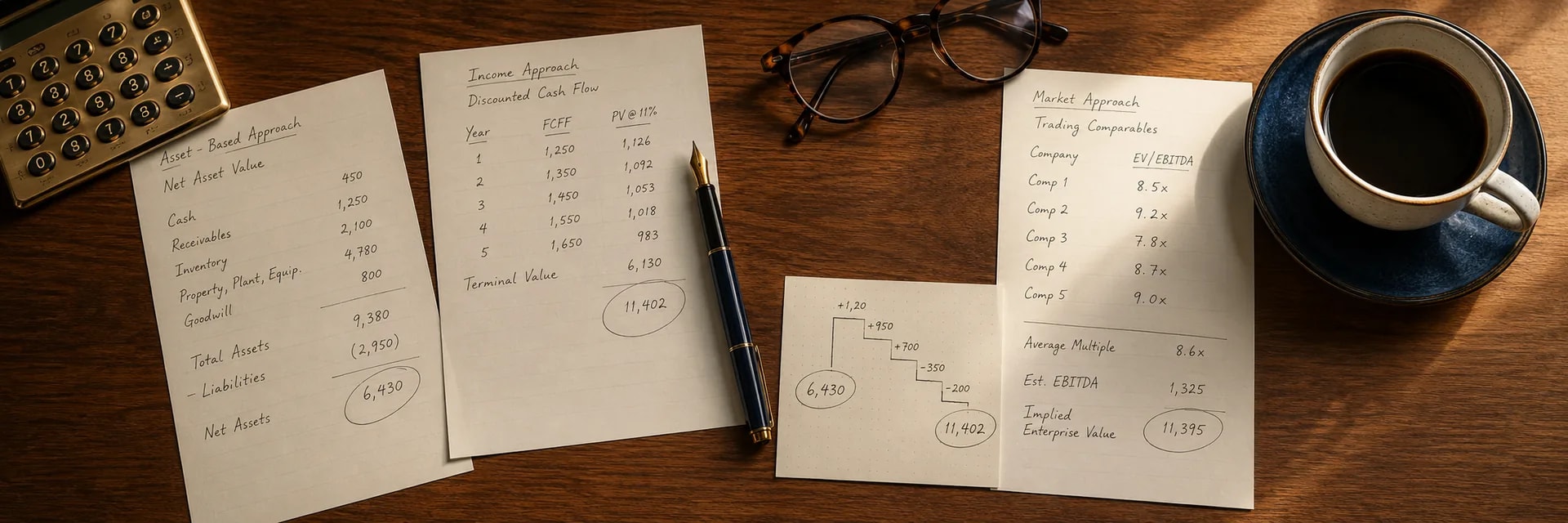
Why valuation methods disagree on the same stock, and a workflow to reconcile valuation methods into a defensible range instead of a misleading average.

June 16, 2026 · Updated June 16, 2026
How to choose the discount rate for a DCF: build the weighted average cost of capital from cost of equity (CAPM) and after-tax cost of debt, step by step.

June 16, 2026 · Updated June 16, 2026
Which valuation method to use depends on the company: a framework for choosing between DCF, multiples, and the Graham formula by business type.

June 4, 2026 · Updated June 4, 2026
Investment research platforms: a valuation-first checklist for trial-testing equity research tools, screening, and the valuation model before subscribing.

June 3, 2026 · Updated June 3, 2026
How the disciplined investor builds a stock analysis valuation framework template across tickers: input architecture, calculation logic, guardrails.

June 1, 2026 · Updated June 1, 2026
A five-layer stocks tools stack the valuation-first investor maintains: universe filter, fundamentals verifier, valuation engine, margin calibrator, monitoring.

May 28, 2026 · Updated May 28, 2026
A six-check rubric for evaluating stock analysis websites: methodology disclosure, data provenance, score traceability, and three more checks.

May 25, 2026 · Updated May 26, 2026
A fundamental analysis checklist: six-category sanity-check routine for verifying fundamentals against primary filings before any DCF or multiples model.

May 22, 2026 · Updated May 26, 2026
Same ticker, different intrinsic values across platforms. A six-check audit covering share count, time period, GAAP vs non-GAAP, and restatement layer.

May 20, 2026 · Updated July 13, 2026
Most DCF errors come from bad inputs, not bad math. A six-category checklist to verify any DCF model before trusting its output.

May 9, 2026 · Updated June 30, 2026
How value investors operationalize margin of safety into a percentage discipline calibrated to forecast reliability, with thresholds by business type.

April 9, 2026
Investment research often yields conflicting valuation models. Learn to diagnose discrepancies and apply an effective equity research process to gain clarity.

April 7, 2026 · Updated April 9, 2026
Stock tracking sites provide better outcomes when combining AI signals with fundamental analysis. Use equity tracking dashboards to improve your research.

April 2, 2026
Evaluate stock market valuation today by using a consistent stock market assessment. Identify relative value across global and domestic equity markets.

March 31, 2026 · Updated June 10, 2026
Explore current market valuation multiples and macro drivers. Apply our benchmarking framework for accurate business valuation in five major industries.

March 26, 2026
U.S. stock market valuation remains high. Analyze how earnings, labor trends, and us equity valuation metrics influence the risk of a market correction.

March 24, 2026 · Updated May 26, 2026
Step-by-step formula to calculate the cyclically-adjusted PE ratio yourself. Data sources, GAAP vs non-GAAP earnings, and macro context for interpreting your result.

March 19, 2026
What the CAPE Shiller ratio actually measures, why it fails as a market-timing signal in modern markets, and how to interpret elevated readings without overreacting.

March 17, 2026
Build effective stock market dashboards using a structured five-layer checklist. Improve your fundamental analysis and avoid reactive investment decisions.

March 12, 2026
The three-view methodology for value-investing graphs — Quality Check overlay (ROIC + margins), Valuation Band (historical multiples), and Intrinsic Value Link (DCF margin of safety).

March 11, 2026
How to audit a stock market visualization platform for data-integrity issues — GAAP vs non-GAAP defaults, survivorship bias, Y-axis manipulation, and audit-trail verification.

March 5, 2026
Understand equity market data infrastructure and risks. Use a reliable equity market data provider for accuracy. Protect your valuation models.

March 3, 2026
A stock market database ensures data quality. Use a global equity data repository to prevent bias and improve your investment valuation models.

February 26, 2026
This shares screener workflow filters stocks for valuation analysis. This equity screener identifies high-quality investment candidates.

February 24, 2026
Three field-tested strategy recipes for configuring your stock screener — Deep Value (P/B < 1, D/E < 0.5), Quality at a Reasonable Price (top-decile ROIC + PEG < 1.5), and Sector Rotation (5-year P/E discount).

February 19, 2026
Interpret stock targets as diagnostic data. Learn the analyst stock targets meaning to build better models. Stop relying on absolute guarantees.

February 17, 2026
Determine share valuation ranges using a business valuation approach. Use fundamental analysis to estimate intrinsic value and protect capital.

February 12, 2026
Use this analysis of stocks to spot red flags. Follow our stock analysis methodology steps to avoid value traps and evaluate leadership integrity.

February 10, 2026 · Updated February 11, 2026
Analyze stock market value using the right metrics. Use the stock market value formula to find real worth. Master market cap and enterprise value.

February 5, 2026 · Updated February 11, 2026
Master stock valuation with this practical workflow.

February 3, 2026 · Updated February 11, 2026
Master stock valuation analysis with professional triangulation techniques.

January 28, 2026 · Updated February 11, 2026
Master the difference between stock price and intrinsic value.
January 26, 2026 · Updated June 10, 2026
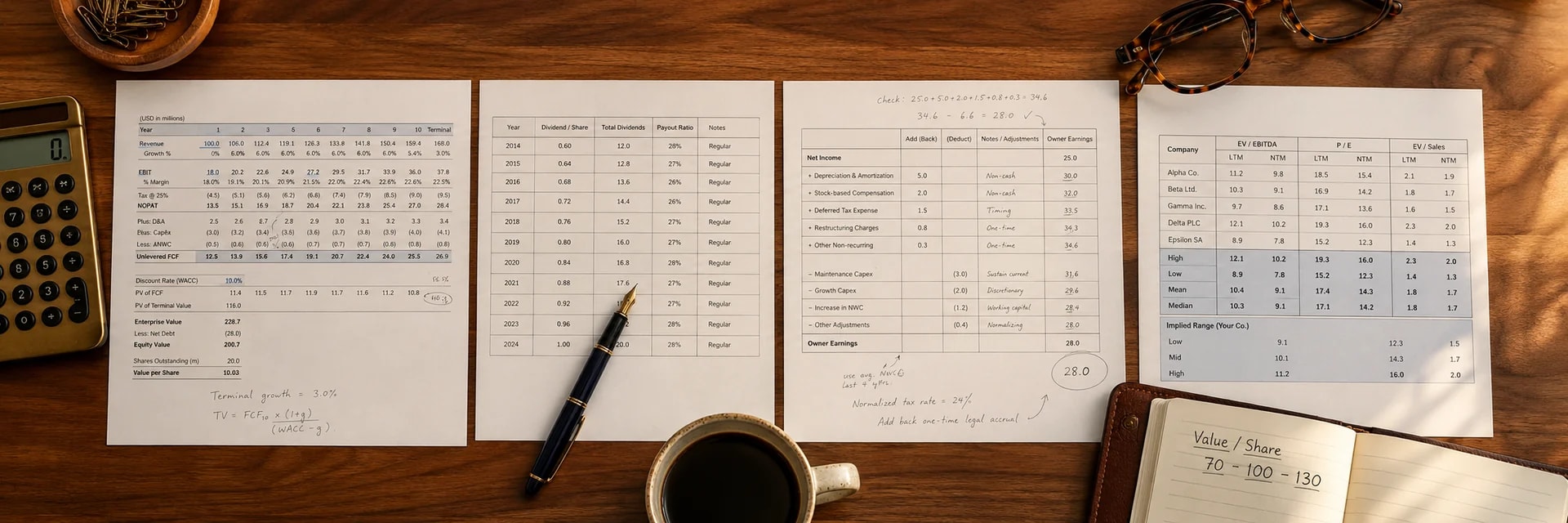
Four stock valuation methods explained: DCF analysis, dividend discount models, owner earnings, and comparable multiples, plus a margin of safety workflow.
Use professional-grade valuation tools to calculate intrinsic value before you invest.
Start Valuing Stocks