
Turning a completed due diligence checklist into a decision takes three moves. Triage each adverse finding into one of three lanes; strengths stay in the dossier as the case for the thesis. A disqualifier ends the analysis regardless of price; a discount widens the margin of safety you will require; a monitor item gets a written revisit trigger. Weigh conflicting findings by severity, persistence, corroboration, and how directly they touch the thesis. Then record one of three verdicts: proceed to the price test, shelve with a trigger, or reject with a reason. The verdict is about the business and the evidence. The price comparison is a separate, later gate.
What a completed due diligence process produces
Due diligence on a stock is the structured collection of evidence about a business before capital is at risk. The SEC's investor-education material on researching investments frames it as the questions an investor should be able to answer before buying any security. In practice the work arrives in layers. Data verification confirms that the numbers a platform shows match the primary filing; the fundamental analysis checklist covers that layer. An earnings-quality review tests whether accurate, audited numbers are being managed toward a flattering result. Safety checks probe solvency, governance, and the moat. A valuation, built on whatever survived, produces a range rather than a point.
Due diligence dossier
The collected output of a completed due diligence process. It holds the verified fundamentals, the earnings-quality read, the safety-check results, notes on the business and its competitive position, and the valuation range with its assumptions. The dossier is evidence. It does not contain a decision.
Every layer traces back to primary documents. The 10-K, the proxy statement, and the footnotes live in the company filings on SEC EDGAR. Each finding in the dossier should carry a pointer to the filing line that produced it. A dossier with sourced findings can be re-checked a quarter later in minutes. One built on recollection cannot be re-checked at all.
Why the due diligence checklist is not the decision
A checklist is an instrument for collecting evidence without skipping steps. That is its whole job, and finishing it feels like arriving. The temptation is to treat completion as permission: every box ticked, therefore a green light. But the checklist only confirms the evidence was gathered. It says nothing about what the evidence means when it points in two directions.
Real dossiers come back mixed. A business converts earnings to cash cleanly but leans on one aggressive revenue-recognition choice. The balance sheet is conservative while the moat shows erosion at the edges. Insiders are buying as customer concentration climbs. A checklist has no mechanism for resolving any of that. It can only report it.
Parts of the decision logic already exist at other points in the workflow. The value-trap safety checklist applies veto logic during the checks: the severe, filing-verified forms of those failures disqualify a company on the spot. Their milder forms, an aggressive choice inside otherwise clean statements or erosion at the edges rather than a broken moat, survive the veto and carry into the triage that follows. The earnings-quality screen converts softer flags into a wider margin of safety. The five-step valuation workflow applies a mechanical price test at the very end. What sits between them is judgment on the mixed middle: dossiers where strong and weak evidence arrive together. That synthesis step is the subject here. It is also distinct from resolving conflicts between outside research sources, which is a data and methodology problem covered separately.
Triage due diligence findings into three lanes
Triage turns a pile of findings into something a decision can rest on. Strengths stay in the dossier as the case for the thesis; they re-enter at the weighing step. Every adverse finding gets exactly one classification, assigned by two questions: can the current filings settle it, and what would it do to the investment if it stayed true?
A disqualifier is evidence that no price makes acceptable. The recurring cases involve capital or trust. Reported earnings that operating cash flow contradicts across multiple years. Refinancing risk the business cannot control. A restatement paired with insider selling into it. When one appears and survives verification against the filing, the analysis is over. Cheapness does not cure a disqualifier, because the number the cheapness is measured against comes from statements the finding has discredited.
A discount is a real weakness that a price can compensate for. Customer concentration, a cyclical revenue base, key-person dependence, a single aggressive accounting choice inside otherwise clean statements. These findings do not end the analysis. They raise the margin of safety the investment must clear before any price test can pass. Write the size of the raise next to the finding that caused it.
A monitor item is an open question the current filings cannot settle. A new competitor whose effect will not show in results for two quarters. Litigation with a bounded range. A margin trend only one year old. Monitor items get a written trigger: the specific future evidence that will convert them into a discount, a disqualifier, or a cleared flag.
Figure 1. Three triage lanes for due diligence findings
Every finding gets one classification, set by what the finding would do to the investment if it stayed true.
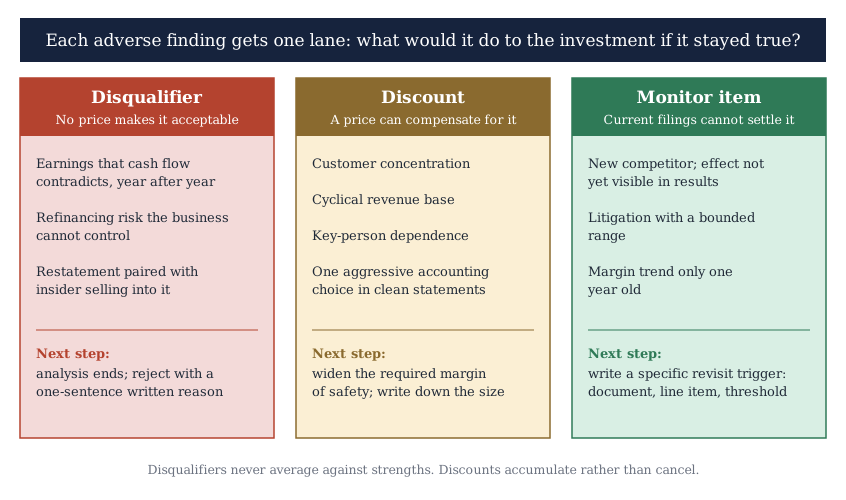
The lanes are not equally full. On most dossiers the monitor lane is the longest and the disqualifier lane is empty or holds one entry. That distribution is normal. The lane assignment matters more than the count, because the lanes behave differently under conflict, which is where the work goes next.
How do you weigh conflicting due diligence findings?
Conflict is the normal state of a completed dossier; a clean, unanimous one is the rarity. Any business worth the hours of a dossier is good at something, and anything cheap enough to interest a value investor is struggling with something. Four tests bring order to the mess.
Severity asks whether the finding, if true, can permanently impair the investment. A pricing misstep costs a quarter; a leveraged balance sheet meeting a refinancing wall can cost the equity. Persistence asks whether the finding is structural, cyclical, or one-off. A cyclical revenue dip reverses on its own; a structural loss of pricing power does not. Corroboration asks whether a second, independent check confirms it. One soft signal is a note; the same signal appearing in both the receivables line and the deferred-revenue line is a finding. Proximity asks how directly it touches the thesis. A weakness in a segment the thesis does not depend on deserves less weight than a small crack in the one it does.
Two rules keep the weighing honest. First, disqualifiers do not average, for two distinct reasons. A capital failure can end the equity before any strength matters. And a trust failure contaminates the case for the strengths: the evidence for a strong moat comes from the same statements the failure has discredited. Second, discounts accumulate rather than cancel. Three medium weaknesses are not neutralized by three strengths; they compound into a wider required margin of safety. At some width the honest conclusion is that no plausible margin of safety covers it.
A note on scores. An aggregate signal such as the Investment Score compresses 28 documented checks across valuation, financial strength, and performance into a single 0-100 number, which makes comparing candidates practical. It earns a place in the dossier as one documented input. The verdict on a mixed dossier stays a judgment, because a composite number cannot know which weakness sits closest to your thesis.
Render the verdict: proceed, shelve, or reject
The verdict is a call on the business and the evidence, recorded before any price comparison. Three outcomes cover every dossier.
Proceed means the dossier supports the thesis. No disqualifiers stand, the discounts have been sized into a required margin of safety, and the monitor items are logged with triggers. Proceed is not a purchase decision. It sends the name to the price test, where the valuation range meets the market price under a margin-of-safety rule. That mechanical comparison belongs to the final stage of the five-step valuation workflow and is deliberately not repeated here. The dossier verdict decides whether the business has earned the price test; the price test decides what happens next.
Shelve means the evidence is unresolved rather than bad. The dominant findings sit in the monitor lane, and the triggers say when they will resolve. A shelved name is parked with its trigger written down, not watched out of the corner of an eye. Shelving is an evidence outcome, distinct from the price-driven watch list at the downstream Decide gate. Shelving without a trigger is procrastination with a filing system.
Reject means the dossier contains a disqualifier, or an accumulation of discounts that no plausible margin of safety covers. Write the reason in one sentence and file it. The sentence matters. It prevents re-litigating the same name every time its price falls, and rejected names tend to reappear at lower prices, looking more tempting each time.
Figure 2. From completed dossier to recorded verdict
The decision step sits between the completed checks and the price test, and produces one of three recorded outcomes.
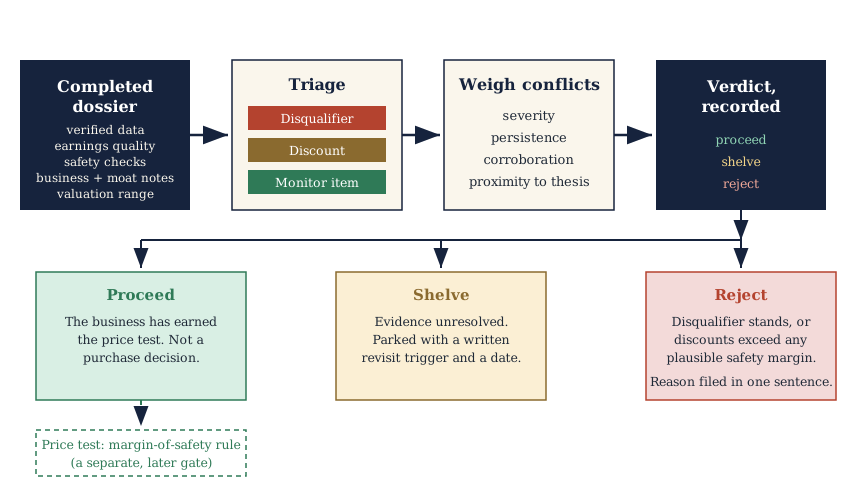
Most verdicts are rejects and shelves. That is the process working as designed. The Berkshire Hathaway shareholder letters show the same discipline practiced in public: reasoning committed to writing, deliberate inactivity as a stated style, acquisition proposals answered within minutes.
Document the verdict and set revisit triggers
A verdict that is not written down decays into an impression within weeks. The record does not need to be long. Five lines cover it: the binding findings by lane, the constraint that drove the verdict, the verdict itself, the trigger that would change it, and the date. For names that go on to a full write-up, the stock valuation report is the long-form home. The verdict note becomes the seed of that report's risk and decision sections.
Revisit triggers earn their own line because vague ones are useless. A trigger like "at the next 10-K, check whether receivables growth is back in line with revenue" can be executed in five minutes on filing day. A trigger like "watch the situation" cannot be executed at all. The best triggers name the document, the line item, and the threshold that changes the lane assignment.
The record also compounds. After a few dozen verdicts, patterns in your own judgment surface: the lane you habitually over-fill, the discount you consistently under-size, the trigger dates you let slip. The file of past verdicts is the only honest data set about your own process. It exists only if the verdicts were written down at the time.
Where the decision step fits in your workflow
The decision step is the narrow end of a funnel. Candidates come from a screen: the stock screener narrows the US universe on fundamentals, and the value stocks slice of the Stock Universe is one starting pool among several. Each candidate that earns the work accumulates a dossier through the verification, quality, and safety layers. The decision step renders the verdict. The price test follows for names that proceed, and the written report records the few that reach full analysis.
Checklist culture in investing usually stops one step short of this. Collecting evidence is systematized; deciding on it is left to feel. The fix is not more checks. It is treating the decision as a step with its own inputs, its own rules, and its own written output. A due diligence process is only as good as the decision it produces, and the decision is only as good as its written reasoning. Ticking the last box is collection. Rendering the verdict is analysis.
InvestViable does not publish buy or sell recommendations on individual securities. All analysis is based on public financial data and a transparent methodology. The Investment Score formula is proprietary; the inputs and what the score evaluates are documented.