
To read a 10-K like a value investor, invert the document. Pass one is Item 8: the auditor's report and its critical audit matters, then the audited statements, cash flow first, then the footnotes where the accounting choices live. Pass two is the MD&A, tested against the audited numbers instead of accepted as framing. Pass three is change-detection: risk factors and legal proceedings compared against last year's filing. The order matters because the audited data anchors your view before the narrative can. Sections read this way feed directly into earnings-quality, solvency, and valuation checks.
What is in a 10-K: the section map
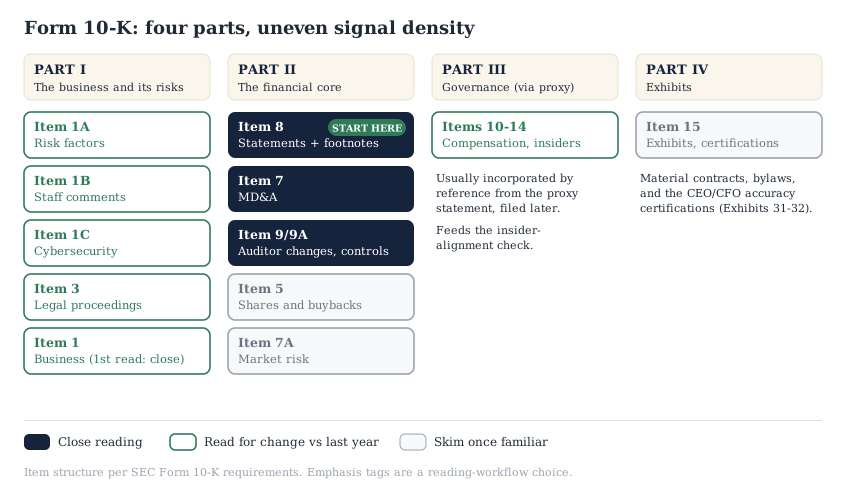
A Form 10-K runs in four parts, with a fixed item structure that SEC rules impose on every filer. That fixed structure is what makes the reading method repeatable across companies. Part I describes the business (Item 1) and the risk factors (Item 1A). It also holds unresolved SEC staff comments (Item 1B), cybersecurity disclosures (Item 1C), and legal proceedings (Item 3). Part II carries the financial core: management's discussion and analysis, the MD&A (Item 7), the audited financial statements and footnotes (Item 8), and internal controls (Item 9A). It also holds share and buyback data (Item 5) and market-risk exposures (Item 7A). Part III covers directors, executive compensation, and insider ownership, and is usually incorporated by reference from the proxy statement filed a month or two later. Part IV lists exhibits, including material contracts and the CEO and CFO certifications of accuracy required by Sarbanes-Oxley, included as Exhibits 31 and 32.
The structure is documented in the SEC's own investor bulletin on reading 10-K and 10-Q filings. Every filing is free on SEC EDGAR, typically posted within 60 to 90 days of fiscal year end depending on filer size. The practical point of the map is allocation. Signal density varies enormously by item. Item 8 and Item 7 repay close reading; Items 1A and 3 repay comparison against last year. Much of the rest is skimmable once the business is familiar.
Figure 1. The 10-K section map: where the signal sits
Four parts, dozens of items, very uneven signal density. Read Item 8 and Item 7 closely, read Items 1A and 3 for change, and skim the rest once the business is familiar.
Why the audited statements come first
Item 8 is where the audit lives. An independent registered accounting firm has examined these statements, on a test basis, and expressed an opinion on whether they fairly present the company's position under GAAP. No other narrative section of the filing carries that assurance. The MD&A is management's own commentary; the risk factors are drafted by counsel; the business description is written to persuade as much as to inform. Reading the audited section first means the rest of the document gets evaluated against verified numbers instead of the other way around.
Within Item 8, read the cash flow statement before the income statement. Reported profit rests on accrual estimates; cash collected does not. The relationship between operating cash flow and net income is the fastest single read on whether earnings are real. It anchors the first disqualifying check in the five-step safety checklist. Then the balance sheet for solvency and share count, then the income statement last, already framed by what cash and capital said.
Two smaller pieces of Item 8 deserve attention on the same pass. The auditor's report states the opinion, the auditor's tenure, and, for nearly all filers other than emerging growth companies, the critical audit matters. Those are matters the auditor communicated to the audit committee that involve material accounts and especially challenging, subjective, or complex judgment, as defined in PCAOB standard AS 3101. Critical audit matters are effectively the auditor pointing at where the estimates are softest, which is a free map for later scrutiny. An opinion that is anything other than unqualified, or explanatory language about going-concern doubt, is reason to stop and understand why before reading on. And Item 9, changes in and disagreements with accountants, should be silent; an auditor change with a disagreement attached is one of the strongest single warnings a filing can contain.
The footnotes are the substance of Item 8
The statements give you totals; the footnotes tell you how those totals were constructed. Accounting standards leave management genuine discretion, and the footnotes are where each choice is disclosed. A reader who skips them sees the output of the judgment without ever seeing the judgment.
Six notes carry most of the weight in a typical filing. The revenue recognition policy explains when a sale becomes revenue, which is where aggressive growth usually starts. The segment note decomposes the consolidated figures into the actual businesses, with their own margins and growth rates. The debt note lays out maturities and covenants, which decide whether a leveraged balance sheet is a schedule or a cliff. Commitments and contingencies hold leases, purchase obligations, and litigation exposure that sit outside the balance sheet totals. Stock-based compensation quantifies a real cost that adjusted profit measures often exclude. And the income tax note frequently reveals where earnings are actually generated.
Footnote reading is also where two downstream disciplines source their raw material. Testing whether reported profit is cash-backed and honestly stated draws on the revenue, receivables, and reserve notes, as laid out in the earnings quality red flags review. Verifying that platform numbers match the filing is the job of the fundamental analysis checklist. That verification depends on knowing which footnote holds the authoritative version of each figure.
How to read the MD&A without absorbing the spin
The MD&A, Item 7, is the most useful unaudited section and the most dangerous one to read first. It is management explaining the year in its own words: what drove results, what liquidity looks like, which trends and uncertainties are known, and which accounting estimates are critical. Read after the statements, it answers questions the numbers raised. Read before them, it frames every number you have not yet seen.
Three parts repay attention. The results discussion should explain the same movements you noticed in the audited data. An MD&A that celebrates revenue growth while receivables grew twice as fast is telling you what management prefers to discuss. The liquidity and capital resources section is the company's own view of its financing needs, worth reading against the debt maturity note. The critical accounting estimates section names the assumptions with the widest ranges. It pairs naturally with the critical audit matters from the auditor's report. When both point at the same account, that account deserves a slow read.
The MD&A is also the main input for building a repeatable earnings base. Known trends, one-off items, and segment commentary are exactly what feeds the adjustments described in normalizing earnings for cyclical businesses. Tone is evidence too. Berkshire Hathaway's shareholder letters have modeled plain-language reporting for decades, and they sit at one end of a spectrum. An MD&A written entirely in defensive boilerplate sits at the other. The distance between the two is informative.
Risk factors, legal proceedings, and what changed
Item 1A is long, lawyered, and mostly generic, which is exactly why it should be read differently: as a diff against last year's filing rather than line by line. Pull both years from EDGAR and compare. A new risk factor, a materially expanded one, or one moved toward the front of the list is management disclosing a live concern under legal cover. Companies generally order risk factors by importance, so promotion within the list is itself a statement. The same technique covers Item 3, where a new proceeding with a specific damages figure means more than pages of routine litigation language. It also covers Item 1B, where any unresolved SEC staff comment is worth understanding before you proceed.
Item 1, the business description, gets one careful read the first time you study a company: how it makes money, who the customers are, where the competitive pressure comes from. In later years it too becomes a change-detection read. Watch for redefined segments, newly emphasized product lines, and quietly dropped language about pricing power. A segment redefinition in particular breaks year-over-year comparability and is easy to miss from summary data alone.
Part III closes the loop on governance. Compensation structure, insider ownership, and related-party transactions usually arrive via the proxy statement, and they inform the leadership-alignment judgment that sits in the middle of the safety checklist. The 10-K tells you what happened; Part III and the proxy tell you who benefits from how it was reported.
Which 10-K section feeds which valuation check
Reading the filing is not an end in itself. Each section is the primary source for a specific downstream check, and knowing the mapping is what turns a two-hundred-page document into a set of targeted extractions.
Figure 2. From filing section to downstream check
Each reading pass sources specific checks. The filing is read once; the checks reuse the extracted material.
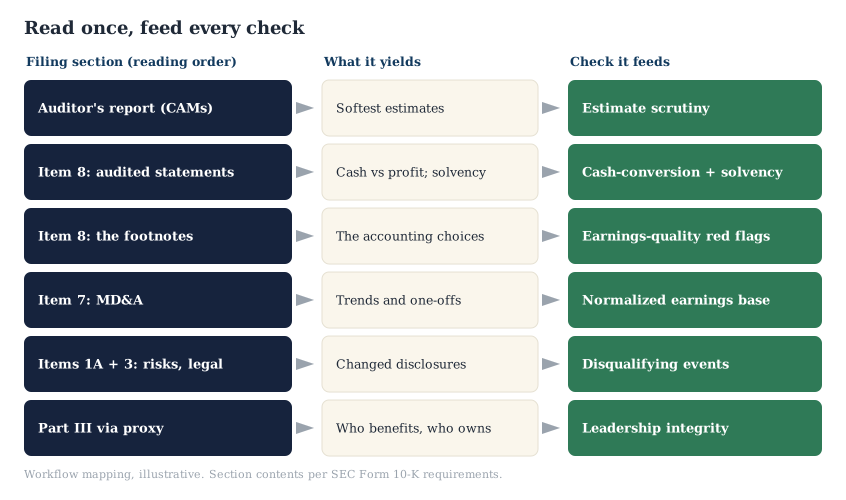
The audited statements feed the cash-conversion and solvency tests that open the analysis of stocks safety checklist. The footnotes feed the earnings-quality screen. The MD&A and segment note feed the normalized earnings base that any multiple or discounted cash flow model should be built on. The proxy material feeds the insider-alignment check. Item 5's buyback history shows whether the company retires shares or merely offsets dilution, which is context for the share-count trend the balance sheet already gave you. Everything extracted along the way becomes source material for the write-up itself, structured as in how to write a stock valuation report. There, each input carries a citation back to the filing section it came from.
Filing time is expensive, so spend it on few names. A sensible division of labor is to let the InvestViable stock screener do the cheap elimination across the universe first. Reserve the full 10-K read for the handful of companies that survive the quantitative filters. Screening decides where to look; the filing decides what you find.
A one-sitting reading routine
A disciplined first read of an unfamiliar 10-K fits in roughly two hours. Ten minutes on the auditor's report and Item 9 for opinion, tenure, critical audit matters, and any accountant disagreement. Forty minutes on the statements, cash flow first, with the share count and debt maturities noted. Thirty minutes on the six high-signal footnotes. Twenty minutes on the MD&A against the numbers already read. Fifteen minutes diffing risk factors and legal proceedings against the prior year, and a first pass through Item 1 if the company is new to you. The goal is not a verdict yet. You leave with filled-in checklist inputs and a short list of questions the next filing must answer. Write those notes down before closing the document. A one-page summary per filing compounds, year over year, into a company history that no third-party summary can reconstruct. The reader who does this five times on the same company ends up knowing it better than most of the commentary written about it.
InvestViable does not publish buy or sell recommendations on individual securities. All analysis is based on public financial data and a transparent methodology. The Investment Score formula is proprietary; the inputs and what the score evaluates are documented.