
Run the transcript in four passes. Pass one isolates the guidance delta: what the range was, what it is now, and which line item moved. Pass two lines the prepared remarks up against the earnings release and the quarterly report, with particular attention to any figure quoted on an adjusted basis. Pass three reads the question-and-answer section for repetition and substitution, because that is the least scripted part of the hour. Pass four opens the prior three transcripts and checks what happened to every commitment that carried a date. Each pass produces written output. Together they turn an hour of talk into a handful of statements that later filings can confirm or contradict.
What an earnings call transcript actually contains
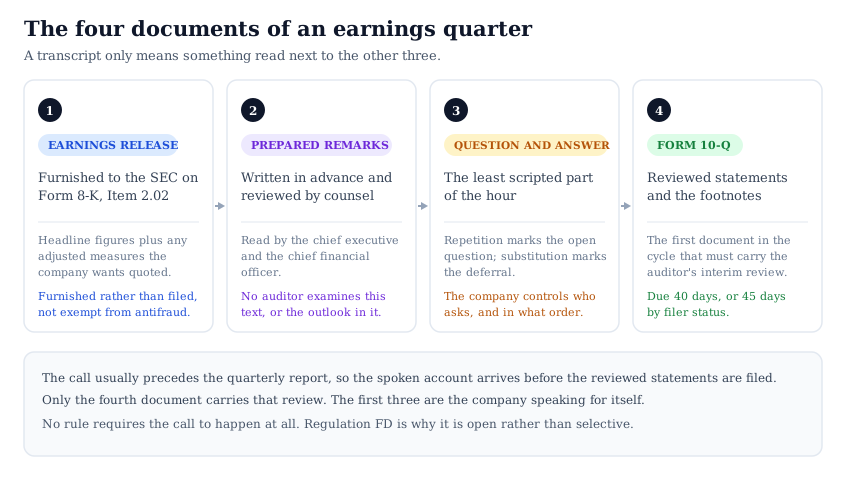
A quarterly earnings call is not one document. It is the spoken middle of a set of four, and the transcript only makes sense when the other three are open next to it.
The first document is the earnings release. A company furnishes it to the SEC on a Form 8-K under Item 2.02, Results of Operations and Financial Condition. It carries the headline figures, plus any adjusted measures the company wants quoted. The word furnished matters. Item 2.02 information is furnished rather than filed, which keeps it out of Section 18 liability and out of automatic incorporation into registration statements. It does not exempt the release from the antifraud rules, which reach what a company says in either posture.
The second document is the prepared remarks, read aloud by the chief executive and the chief financial officer. These are written in advance and reviewed by counsel before anyone speaks. The third is the question-and-answer section, which is the least scripted portion of the hour. The fourth is the Form 10-Q, which arrives afterward and carries the statements the auditor has reviewed under AS 4105, plus the footnotes. The 10-Q is due 40 days after the quarter closes for accelerated and large accelerated filers, and 45 days for everyone else. The call almost always precedes it.
No rule requires a company to hold an earnings call. What regulation shapes is who gets to hear it. Regulation FD was adopted in 2000 and took effect on October 23 of that year. It covers disclosures of material nonpublic information to a defined set of recipients. These include broker-dealers, investment advisers and holders when it is reasonably foreseeable that they will trade on what they hear. When the selective disclosure is intentional, the public disclosure has to be simultaneous. When it is not intentional, the public disclosure has to follow promptly. An open-access call with a public replay is the standard way companies stay on the right side of that.
A company may disclose genuinely new material information on the call, and often does. What it may not do is hand that information to a subset of the market first. For an outside analyst the transcript is therefore a primary source in its own right.
Transcripts themselves are not filings. Most companies post a replay and a written transcript in their own investor relations section within a few days. Third-party versions also exist, and they do not always handle crosstalk, partial sentences and speaker attribution the same way. When a sentence is going to carry weight in your notes, take it from the company's own version or from the replay audio.
Pass one: what changed in management guidance
Guidance is the only part of the call that speaks about periods no statement covers yet, which makes it the highest-value paragraph in the transcript. It is also the part most often summarized away.
Read the guidance as a delta, never as a level. Write down last quarter's range and this quarter's range for every metric the company guides. Revenue, margin, capital spending and the tax rate are the common four. Three properties of the change carry information. Direction tells you whether the outlook improved. Width tells you how much the company thinks it knows: a range that widens signals lower confidence even when the midpoint holds. Composition tells you where the change came from, which is why the full-year figure alone is rarely enough.
An example makes the composition point concrete. A company can hold its full-year revenue guidance while lowering the current quarter and raising the fourth. That is not an unchanged outlook. It is a deferral, and the transcript usually contains a sentence explaining it. That sentence is the one to extract.
Two further habits are worth building. Note where in the range management points. A company that guides to a range and then says it expects results toward the lower half has issued a revision without changing a number. Note also which metrics stopped being guided. Companies discontinue guidance on individual segments or line items with little ceremony, and the discontinuation is rarely the headline. A metric that was guided for six quarters and is now described only qualitatively has moved out of the checkable column. That is a change in what the company is willing to be held to.
Guidance is also where the wording earns attention. Companies attach forward-looking statement language to these figures for a reason, and the assumptions behind a range are often stated in a single conditional clause. A margin outlook that depends on a pricing action not yet taken is a different object from one that depends on cost already removed. Both produce the same number. Only one of them is under the company's control.
Where guidance lands next is in the earnings base you build. The adjustments described in normalizing earnings for cyclical businesses draw on exactly this material, because management's own account of what is temporary is evidence even when it is not conclusive.
Pass two: read the prepared remarks against the reported numbers
The prepared remarks are a written document performed aloud. Read them the way you would read a management discussion section, which means read them second, after the numbers.
Start with the adjusted figures. Most calls quote at least one measure that does not appear in the GAAP statements. Adjusted earnings per share, adjusted operating margin, and a company-specific definition of free cash flow are the common ones. Regulation G and Item 10(e) of Regulation S-K set the rules here, and Instruction 2 to Item 2.02 carries them into the earnings release. A reconciliation to the most directly comparable GAAP measure is required, and the GAAP measure has to appear with equal or greater prominence. The staff's interpretations of those rules explain how they are applied in practice. Question 100.01 states that excluding normal, recurring cash operating expenses can make an adjusted measure misleading.
So run three checks on the adjustment set, and run them across quarters rather than within one. Has the definition changed? A company that adds a new exclusion this quarter has made this quarter's adjusted figure incomparable to last year's. Does the same exclusion appear every period? A charge that recurs quarter after quarter has stopped being exceptional, whatever the label says. Your job in this pass is to notice that the label persisted, not to re-derive the accounting. Does the reconciliation move in one direction only? Adjustments that always lift the reported number are a presentation choice.
The second check on the prepared remarks is arithmetic consistency. Management describes growth, margin movement and cash generation in words. Those words should match the release you have open. When the remarks emphasize a metric the company did not emphasize last quarter, note the substitution. Companies rarely change their preferred measure while it is flattering.
Growth descriptions repay the same care. A single quarter can be described on several bases: against the prior year, against the prior quarter, on a constant-currency basis, or excluding an acquisition. Each basis is legitimate and each produces a different number. The one management leads with is a choice, and the choice moves around. Record which basis was used, not only the percentage, because a figure carried into a model without its basis is a figure that cannot be reconciled three quarters later.
This is a narrower exercise than testing the accounting itself. The mechanics of accruals, capitalization and reserve movement belong to earnings quality and the red flags in the statements. Pass two assumes those numbers are what they are, and asks only whether the spoken account of them is faithful.
Pass three: the question-and-answer section is the least scripted part
Everything before the operator opens the line was written in advance. Everything after it was not, which is why experienced readers start there and work backward.
Two patterns carry most of the signal. The first is repetition. When two or three analysts ask about the same item in different words, the sell side has collectively decided it did not get an answer. That item is the quarter's open question, and it is worth rebuilding from the filings yourself rather than taking from the call. The second pattern is substitution. A question about unit volume answered with a revenue figure has not been answered. A question about a specific segment answered at the consolidated level has not been answered either. Substitution is legal, common, and informative about where management would rather not go.
Quantity matters alongside content. Count the questions and count the questioners across several quarters. A call that drew fourteen questions a year ago and draws five now has lost coverage, and thinner coverage means fewer people checking the company's account of itself. That shift belongs in your notes even though it says nothing about the business.
Read the Q&A in the order it happened. The order is the company's choice, and the early slots usually go to the largest covering firms. What arrives at the end is often the more awkward material, asked by whoever was still in the queue.
Format is part of the evidence. Some companies take live questions from an open line. Some restrict each analyst to a single question with no follow-up. Some take questions submitted in writing beforehand and read them aloud, which removes the follow-up entirely. These are disclosure choices, and a company that moves from the first format to the third has reduced the amount of unscripted material in its own transcript. Note the change when it happens, because the transcripts on either side of it are not comparable documents.
One boundary is worth stating. This pass is about the questions, not about the price targets the questioners publish afterward. Those targets are a separate object with their own failure modes, covered in deconstructing analyst stock targets. A transcript tells you what analysts wanted to know. It does not tell you whether their models are any good.
Pass four: build a promise ledger across calls
A single transcript is an assertion. Four consecutive transcripts are a record, and the record is where the value sits.
Management makes commitments on calls. Some are operational: a margin target by a stated year, or a cost program of a stated size. Others are financial: a leverage ratio by a stated date, or a capital return plan of a stated amount. Each commitment has three parts worth recording separately. There is the claim itself, the horizon attached to it, and the filing line where it would eventually show up. Without the third part, a commitment cannot be checked; it can only be remembered.
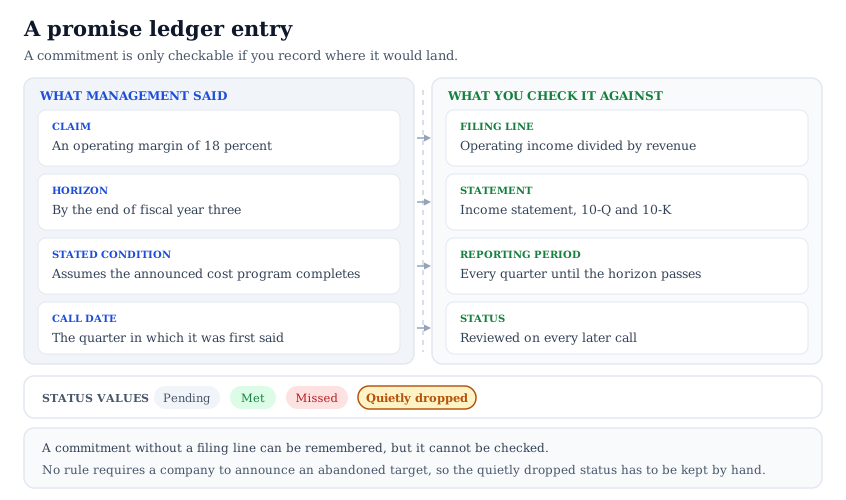
One status repays the effort on its own: the commitment that is quietly dropped. Commitments that are met get celebrated on a later call, and commitments that are missed usually get addressed. Commitments that simply stop being mentioned are the interesting category. No rule requires a company to announce an abandoned target as such, so the disappearance generates no event and no headline. A metric that appeared in four consecutive calls and then disappeared is a finding you can only make by having written it down.
Capital return promises are the easiest to verify, because the cash flow statement records what actually happened. A buyback authorization announced on a call and never executed shows up as an absence, and the methods for reading that are set out in analyzing buybacks and insider activity. Operating targets take longer to resolve and are worth the same treatment.
The ledger also removes the need to trust recall. A commitment recalled after the outcome is known is a commitment you can no longer quote. A written entry carries the original wording, the date and the stated condition, which is what makes the later comparison possible. It also changes what the next call is for. Instead of listening to the whole hour with equal attention, you arrive with four open items and a specific reason to care about each answer.
Everything in the ledger traces back to a source document. The SEC's EDGAR filing search holds the 8-K releases and the quarterly reports, and the company's own investor relations pages hold the transcripts and replays.
What a transcript cannot settle
The limits are as important as the method, because a transcript invites more confidence than it earns.
It is unaudited throughout. No auditor examines the prepared remarks, the adjusted figures quoted aloud, or the outlook attached to them. The reviewed numbers arrive later in the 10-Q, and reading the filing itself remains the primary exercise. A transcript supplements that reading and never substitutes for it.
The company controls the room. It chooses the speakers, the order of the queue, and how long the call runs. An analyst whose questions have been unwelcome may not be called at all, and nothing in the transcript records the questions that were never asked.
Tone is the weakest evidence in the document. Hesitation, confidence and word choice feel informative, but a single transcript cannot support a conclusion drawn from them. Note tone and revisit it later, and keep it out of the decision.
The reading is also vulnerable to hindsight. A transcript read after the fact, with the next two quarters already known, will seem to contain warnings that nobody could have extracted at the time. This is why the ledger is dated and the notes are written before the outcome arrives. A method that only produces findings in retrospect is not a method.
One more limit is structural. Executives change, and the person who made a commitment three years ago may not be the person answering for it now. A transcript records what the company said, but a company is not a continuous author. When the chief financial officer changes, treat the ledger as carrying forward only the commitments the new incumbent has reaffirmed on a later call.
Finally, the transcript is not a substitute for the balance sheet. A company can describe an excellent quarter while failing the solvency and cash conversion tests in the safety checklist for avoiding value traps. The checklist runs on filed numbers and disqualifies on them. Nothing said on a call reverses that.
Where earnings call analysis enters the valuation
The transcript work sits between verification and forecasting. The data has already been checked against the filing, and the model has not yet been fixed.
Guidance feeds one input directly. A discounted cash flow model built in the InvestViable Valuator takes a cash flow growth path, a discount rate and a terminal growth rate. The near years of that growth path are exactly what a company guides. The call tells you what management expects and, more usefully, what that expectation depends on. The stated condition is the part to carry into the model, because it is the assumption that can fail.
Guidance also gives you something to price against. A reverse discounted cash flow solves for the growth the current price already implies. Setting that implied figure next to the guided figure produces a gap, and the gap is a question rather than a verdict. It asks which of the two assumptions you are willing to defend, and on what evidence.
The Investment Score is deliberately outside this. It is computed from reported fundamentals across valuation, financial strength and performance, and nothing management says on a call moves it. That separation is the point. A quantitative score and a spoken narrative are different kinds of evidence, and blending them into one number hides which evidence moved the answer. Narrowing the universe is a job for filed data too. The stock screener does that across US equities, and quality stocks in our Stock Universe are one published slice of the same universe. Transcripts are expensive to read properly, so reserve them for names that survived the quantitative pass.
The output of all four passes belongs in writing, next to the valuation itself. The fields to keep are the ones set out in what to record for every stock you own. The decision they eventually feed is the due diligence process from checklist to decision. Eight quarters of this produces an artifact no summary reproduces: a dated record of what management promised, next to what the filings later showed.
InvestViable does not publish buy or sell recommendations on individual securities. All analysis is based on public financial data and a transparent methodology. The Investment Score formula is proprietary; the inputs and what the score evaluates are documented.