
Introduction
Financial markets present AI-driven platforms and traditional fundamental analysis tools as competing paradigms. This persistent framing misleads people because they navigate between algorithmic signals and manual due diligence. Stock tracking sites often force users to choose between trusting opaque algorithms and conducting exhaustive manual research.
However, Harvard Business Review research indicates that sophisticated AI users treat systems as reasoning partners instead of productivity tools. This principle applies directly to investment analysis. Measurable investment outcomes depend less on the selected methodology and more on whether the chosen platform operates with genuine transparency. Transparent platforms allow users to integrate both approaches so they do not blindly rely on either methodology.
Disclaimer: This article provides educational information rather than investment advice. The discussed scenarios and examples illustrate evaluation criteria, and they do not serve as recommendations.
Why "AI vs. traditional" framework misleads investors
Stock tracking sites increasingly market themselves along a sharp divide. Algorithmic intelligence sits on one side, and fundamental rigor sits on the other. This framework sells subscriptions, but it does not reflect how investment outcomes actually improve.
This binary positioning ignores a growing body of evidence. A Harvard Business School research study found that 94% of respondents favor using AI to augment human work rather than replace it. That finding extends naturally to stock portfolio dashboards. Investors benefit most when algorithmic screening and fundamental evaluation operate together rather than in competition. Platforms that force a choice between these methodologies strip away the clarity that investors need to evaluate both signal quality and business value simultaneously.
Marketing from AI-focused platforms emphasizes speed and pattern detection. Marketing from traditional platforms emphasizes depth and analytical discipline. Neither camp acknowledges the conditions under which its preferred method fails. AI signals lose reliability during regime shifts. Traditional analysis struggles with cross-market correlation at scale. Investors who commit fully to one methodology inherit its blind spots without any compensating strength from the other.
The more productive question explores whether a given platform exposes its reasoning transparently enough for investors to verify its outputs. Reliable stock market database comparisons reveal that data quality and methodological transparency vary enormously across providers. These differences shape investment outcomes more than the AI-versus-traditional label ever could. The methodology debate distracts from this structural problem, and that distraction carries real cost because opaque platforms hide critical information from retail investors.
What black-box stock tracking sites hide from retail investors
Algorithmic opacity poses a measurable risk that most stock tracking sites do not disclose. When platforms present AI-generated confidence scores without revealing the underlying logic, investors fail to distinguish precision from noise. This gap creates conditions for significant financial harm.
The BlueCrest Capital Management enforcement case illustrates this problem at an institutional scale. BlueCrest designed its algorithmic replication system to mirror the performance of live traders. However, this system underperformed its target portfolio by an average of $25 million per month due to execution lag and timing vulnerabilities. The firm ultimately agreed to pay a $170 million SEC settlement in 2020. If a well-resourced institutional firm failed to detect and correct algorithmic underperformance internally, retail investors who use opaque platforms face even steeper odds.
Retail-facing platforms compound this risk in ways that discourage scrutiny. Common patterns include the following practices:
-
Platforms display accuracy percentages without publishing the methodology or time horizon that calculates them.
-
Platforms present back tested results as forward-looking performance indicators without disclosing survivorship bias or curve-fitting limitations.
-
Platforms package algorithmic complexity as a feature rather than a transparency obligation.
A FINRA Foundation study found that 89% of investors do not believe they have been targeted in scams. This finding suggests that overconfidence in platform accuracy runs deep. Investors who evaluate equity market data infrastructure and its valuation risks need platforms that expose their reasoning to scrutiny rather than platforms that use complexity to project authority.
When traditional analysis still wins
Algorithmic models perform well in stable conditions with abundant historical data. When those conditions disappear, traditional fundamental analysis provides something that algorithms cannot provide. Fundamental analysis offers the ability to reason about situations that have never occurred before.
Research from the University of Notre Dame demonstrated that retail investor attention predicts lower returns within one week. This finding highlights a structural problem for AI tools that ingest sentiment data. Algorithms that rely on retail attention signals may amplify herding behavior rather than counteract it. This dynamic worsens during the exact market conditions where investors most need analytical exactness. Platforms that rely solely on algorithmic pattern recognition inherit this vulnerability without offering certainty about when their models will break down.
Three specific conditions consistently expose the limits of algorithmic analysis.
Volatile markets with false signals
Market volatility increases retail trading activity. This surge in activity generates noise that algorithmic models struggle to separate from genuine signals. A study that was published in the Journal of Risk and Financial Management found that strong retail investor bullish sentiment correlates with lower returns. This correlation means the signal that AI tools detect most strongly during volatile periods often points in the wrong direction.
Algorithms that rely on historical price patterns interpret volume spikes and sentiment clusters as actionable data. During volatile markets, panic selling, momentum chasing, and social media amplification contaminate these inputs. The sharpness of an algorithmic signal does not matter if the underlying data reflects crowd psychology rather than fundamental value.
False signals proliferate precisely when investors need reliable guidance most. Traditional analysis offers a counterweight to this problem. Traditional analysts evaluate whether a company's cash flows, competitive position, and balance sheet justify its current price regardless of short-term sentiment, and this fundamental evaluation remains necessary when market environments undergo major changes.
Regime shifts during novel situations
Algorithmic models depend on the repetition of historical patterns. Regime shifts break this assumption entirely. Historical training data offers little predictive value when central banks reverse decades-long monetary policy, when new regulatory frameworks reshape entire industries, or when geopolitical events create unprecedented supply chain disruptions.
Human analysts evaluate novel situations by reasoning from first principles. A traditional analyst who examines a company that faces an unprecedented tariff regime can assess management's operational flexibility, supplier diversification, and balance sheet strength to estimate probable outcomes.
An algorithm without comparable training data produces outputs based on the closest historical analogy. This analogy may mislead investors.
Business fundamentals in equity tracking dashboards
When algorithmic signals become unreliable, fundamental analysis provides an anchor that prevents reactive decision-making. Investors establish a reference point that exists independently of market sentiment or algorithmic interpretation when they evaluate a company's revenue durability, competitive moat, management track record, and capital allocation discipline.
This anchor matters because it enables independent verification. An investor who understands why a company generates free cash flow can evaluate whether a sell signal from an AI tool reflects genuine deterioration or temporary market dislocation.
Without that understanding, the investor lacks a basis to disagree with the algorithm. Investor also lacks the confidence to hold a position through short-term volatility. Fundamental analysis does not replace algorithmic tools. Instead, it provides the baseline judgment that makes algorithmic outputs useful rather than authoritative.
When AI signals add genuine value to stock tracking sites
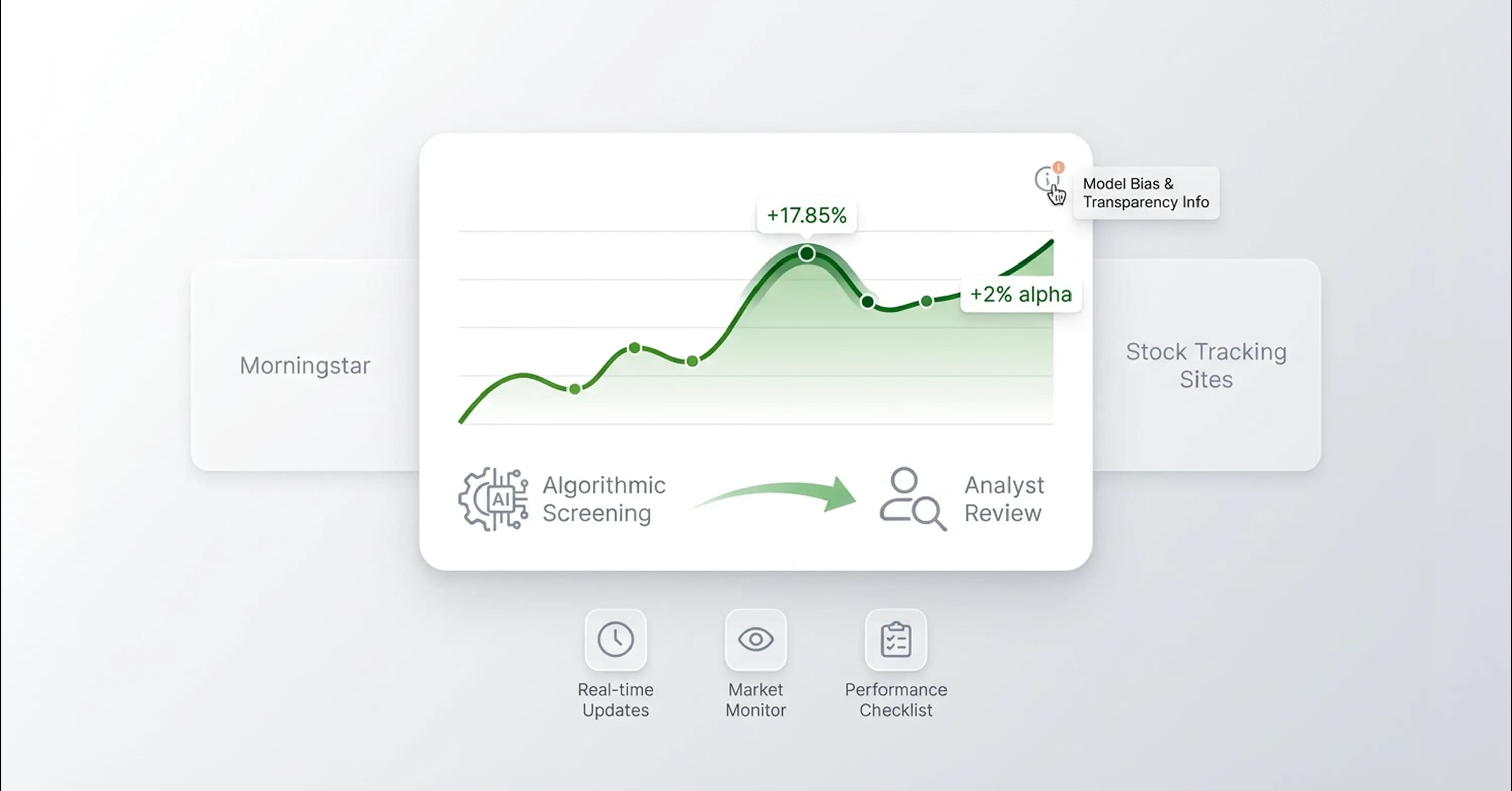
Algorithmic tools earn their place in an investor's workflow when they apply to tasks that exceed human mental capacity. Algorithms process thousands of securities across multiple markets simultaneously. They detect cross-asset correlation shifts in real time and screen for momentum characteristics across entire universes of stocks. These capabilities represent genuine advantages that no individual analyst can replicate manually.
Momentum screening illustrates this advantage with measurable exactness. Morningstar's analysis of deep-value portfolios found that adding momentum screening improved returns to approximately 17.85% annually, and this generated nearly 2% additional alpha over unscreened portfolios. An individual analyst would need days to manually run these screens across hundreds of securities and complete what an algorithm finishes in seconds. Stock tracking sites that automate this screening layer save investors time and reduce the likelihood of overlooking candidates that meet specific quantitative thresholds.
The clarity these tools provide matters most when investors use them selectively rather than deferentially. High-performing users treat algorithmic outputs as a filtered starting point for deeper evaluation rather than as a final verdict. They let equity tracking dashboards handle the pattern recognition workload and then apply their own judgment to the shortlisted results.
Investors who accept every algorithmic recommendation without scrutiny tend to inherit model-specific biases rather than correct for them. The value of AI signals depends on how deliberately an investor integrates those signals into a broader analytical process. This integration requires understanding both what the algorithm detected and what it could not evaluate, and investors achieve this integration when they use transparent platforms that combine both methodologies.
How transparent platforms bridge both worlds
Stock tracking sites that expose both algorithmic signals and fundamental data within a single interface create conditions for better decision-making. When investors see why an algorithm flagged a security and simultaneously evaluate the underlying business metrics, they develop the rigor they need to distinguish genuine opportunities from statistical artifacts.
Harvard Business Review research confirms that how investors use AI matters more than how often they use it. This finding reinforces a practical truth that process discipline drives performance more than tool sophistication. An investor who follows a structured evaluation workflow on a basic platform will outperform an investor who accesses advanced equity tracking dashboards but applies those tools inconsistently.
FINRA's key challenges report on artificial intelligence emphasizes that AI tools in finance require explainability and bias management oversight. Transparent stock portfolio dashboards address this requirement because they build verification directly into the investor's workflow. A practical integration framework follows three steps:
-
Algorithmic filters screen the investment universe to identify momentum, valuation, or quality characteristics that match a predefined strategy.
-
Investors evaluate flagged securities against fundamental criteria, such as cash flow durability, competitive positioning, and balance sheet strength, and they review the platform's underlying data to avoid trusting the algorithmic score alone.
-
Investors document the reasoning behind each decision to create an auditable record that separates signal-driven precision from judgment-driven conclusions.
How InvestViable closes gap between AI signals and fundamental analysis
The three-step framework above requires a platform that exposes its reasoning at every stage rather than a platform that hides logic behind confidence scores. InvestViable operates on this principle. The platform combines automated due diligence checks with valuation tools that use Discounted Cash Flow, EBITDA multiples, and the Graham formula. It then presents these outputs in plain-language explanations so investors can verify the reasoning behind each score rather than accept an opaque number.
This transparency matters because it addresses the core problem this article identifies. InvestViable gives retail investors institutional-grade analysis without the institutional-grade opacity. The scoring system breaks down a company's strengths and weaknesses based on the latest financial data, and the educational resources help investors understand the valuation techniques themselves.
Conclusion
To summarize, the debate between AI signals and traditional analysis on stock tracking sites represents a false dichotomy that costs investors returns and erodes analytical discipline. AI-driven tools add value in specific conditions like momentum screening and cross-market pattern detection. Traditional fundamental analysis provides necessary anchoring during regime shifts, volatile markets, and novel situations where historical training data fails.
Transparent platforms integrate both methodologies and expose their reasoning to investor scrutiny, and this combination produces superior decision-making frameworks. InvestViable combines this integrated approach. To see how transparent analysis changes your investment workflow, explore InvestViable's valuation tools or jump straight into the stock screener — 51 pre-built screens organized by sector, investment style, or theme, each surfacing the same 28-check Investment Score on every stock.