
To choose a discount rate for a DCF, build the weighted average cost of capital (WACC). Estimate the cost of equity with the capital asset pricing model, which is the risk-free rate plus beta times the equity risk premium. Estimate the after-tax cost of debt from the company's current borrowing rate. Then weight the two by the market values of equity and debt. For an equity-only DCF that discounts cash flow to shareholders, use the cost of equity directly rather than the blended rate.
What the discount rate represents in a DCF
The DCF guide names the discount rate as one of three inputs that drive a valuation, alongside the cash flow path and the terminal growth rate. It is also the input analysts understand least, because it looks like a single number when it is actually a small model in its own right.
The discount rate answers one question: what annual return would a rational investor demand to accept this stream of cash flows, given how risky those cash flows are? Two forces set it. The first is opportunity cost, the return available on a safe alternative. The second is a risk premium, the extra return required for bearing uncertainty the safe alternative does not carry.
That structure has a hard floor. The safe alternative is a government bond, so the cost of equity should sit above the current 10-year Treasury yield. If a model's cost of equity comes out below what a Treasury bond pays, the model is broken, not the market: it implies the stock is less risky than a sovereign bond. A full WACC can sit a little lower once cheap, tax-shielded debt is blended in, but the equity component never should.
The mechanics are simple and unforgiving. A higher discount rate pulls every future cash flow toward a smaller present value, and the effect compounds with time, so distant cash flows shrink faster than near ones. A growth company whose value sits mostly in cash flows ten years out is far more sensitive to the rate than a mature company whose value arrives sooner. Choosing the rate carefully is therefore not a finishing touch. It is one of the two or three decisions that determine the answer.
How to calculate the discount rate: building WACC
For a DCF that values the entire firm, the standard discount rate is the weighted average cost of capital (WACC). A company is usually financed by a mix of equity and debt, and each source has its own required return. WACC blends them in proportion to how much of the firm each one funds.
The formula has three moving parts:
-
Cost of equity: the return shareholders require, weighted by the share of the firm financed by equity.
-
After-tax cost of debt: the rate lenders charge, reduced for the tax deductibility of interest, weighted by the share financed by debt.
-
Weights: the market value of equity and the market value of debt, each divided by their combined total.
Figure 1. Building the discount rate from its components
How the cost of equity and the after-tax cost of debt combine, weighted by capital structure, into a single weighted average cost of capital.
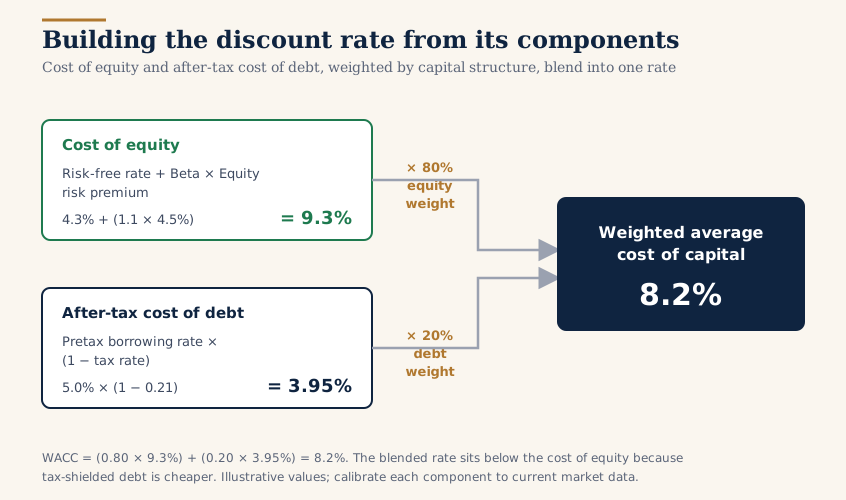
Knowing how to calculate the discount rate this way matters because it makes the number auditable. A WACC you can break into a cost of equity, an after-tax cost of debt, and two weights is a number you can defend or revise. A WACC pulled whole from a template is a guess wearing a decimal point. The two sections that follow build each side of the blend before combining them into a single worked figure.
Cost of equity: the CAPM build-up
The dominant method for estimating the cost of equity is the capital asset pricing model (CAPM). It expresses the return shareholders require as the risk-free rate plus a risk premium scaled to the stock's volatility relative to the market:
Cost of equity = Risk-free rate + Beta × Equity risk premium
Each input has a defensible source:
-
Risk-free rate. Use the current 10-year Treasury yield for a U.S. equity, matching the bond's term roughly to the forecast horizon. It is observable; do not carry a stale figure from an old model.
-
Beta. Beta measures how much the stock moves when the market moves, with 1.0 being market-average. You can take a regression beta against a broad index or an industry (bottom-up) beta derived from comparable firms. The bottom-up version is usually steadier for a single company. Whether your beta is stale, run over the wrong window, or in need of a Blume or Vasicek adjustment is an audit question; the DCF inputs checklist covers that verification, while the goal here is to plug in a defensible starting figure.
-
Equity risk premium. This is the extra return investors demand for holding equities over government bonds. Aswath Damodaran's implied equity risk premium estimates, kept current for the year, are the practitioner reference. A fixed premium plugged in regardless of conditions inherits a calibration from a different market.
Work an example. With a 4.3 percent risk-free rate, a beta of 1.1, and a 4.5 percent equity risk premium, the cost of equity is 4.3 + (1.1 × 4.5), or about 9.3 percent. Change the beta to 1.3 and the cost of equity rises to roughly 10.2 percent. That sensitivity is exactly why each input deserves a current source rather than a habit.
After-tax cost of debt and the capital-structure weights
The second building block is the cost of debt, the rate the company would pay to borrow today. Use the firm's current marginal borrowing rate, proxied by recent debt issuance or the yield on its bonds in the open market. Do not use the coupon on legacy debt issued in a different rate environment. The most recent 10-K and 10-Q filings on SEC EDGAR disclose interest expense and debt balances you can use to sanity-check the figure.
Debt is then adjusted for taxes. Because interest is tax-deductible, the real cost to the firm is the rate times one minus the tax rate. A 5 percent pretax borrowing rate at a 21 percent tax rate becomes an after-tax cost of debt of about 3.95 percent. Debt sits below equity in the cost stack because lenders bear less risk than shareholders. The tax shield lowers the cost of debt further.
The weights come from market values, not book values. Equity weight is the market capitalization; debt weight is the market value of debt, which book value approximates well enough for most non-distressed firms. Divide each by their combined total.
Now combine everything. Take the 9.3 percent cost of equity from the previous section, an after-tax cost of debt of 3.95 percent, and a capital structure that is 80 percent equity and 20 percent debt by market value:
WACC = (0.80 × 9.3%) + (0.20 × 3.95%) = 7.44% + 0.79% = 8.2%
That 8.2 percent is the discount rate for a firm-level DCF. Notice it sits below the 9.3 percent cost of equity, pulled down by the cheaper, tax-shielded debt. The more debt in the structure, the wider that gap, until rising default risk starts pushing the cost of debt itself upward.
When the cost of equity beats a full WACC
WACC is not always the right rate. The choice depends on which cash flow you are discounting, and matching the two is non-negotiable.
If you forecast free cash flow to the firm, the cash available to all capital providers before financing, discount it at WACC. If you forecast free cash flow to equity, the cash left for shareholders after interest and debt repayment, discount it at the cost of equity instead. Using WACC on equity cash flows credits the firm twice for cheap debt, once in the lower rate and once in the cash flow that already excludes interest.
Three situations push toward the cost of equity directly:
-
Negligible debt. For a company that carries little or no debt, the weights collapse and WACC converges on the cost of equity anyway. Building a full WACC adds steps without changing the answer.
-
Banks and insurers. For financial firms, debt is raw material rather than financing, so the firm-level WACC framework does not apply cleanly. Practitioners value these businesses on equity cash flows discounted at the cost of equity.
-
Private and small companies. Here analysts often add a size or company-specific premium on top of the CAPM cost of equity to reflect illiquidity and concentration. Damodaran's data on costs of capital by industry gives a benchmark to check that premium against rather than inventing one.
The discipline is consistency. Pick the cash flow definition first, then the matching rate. A model that discounts shareholder cash flow at WACC is not conservative or aggressive; it is simply wrong by construction.
Sizing the error: how much the rate moves the answer
The discount rate earns its scrutiny because small changes in it produce large changes in value. The effect is largest for companies whose cash flows arrive far in the future.
Figure 2. How the discount rate moves intrinsic value
Per-share intrinsic value for one set of cash flows discounted at rates from 7 to 11 percent, holding every other input fixed.
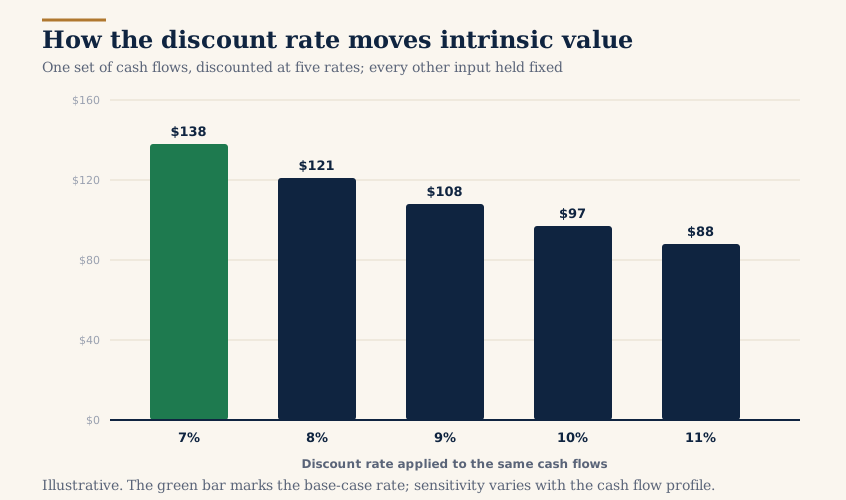
That leverage creates a trap. Because the rate moves the answer so much, it is tempting to load every worry into it. An analyst might nudge the rate up for a risky business, then haircut the cash flows for the same risk, then take a margin of safety on top. That stacks the same risk three times and produces a value too low to mean anything. The cleaner discipline is to decide where each risk belongs. Forecast risk lives in the cash flow scenarios. Capital-market risk lives in the discount rate, anchored to current data. The remaining estimation error lives in the margin of safety, a buffer applied after the valuation, not baked into its inputs.
The rate is also a leading reason two analysts reach different intrinsic values for the same company, and a leading reason platform valuations diverge from your own. Seeing why valuation outputs differ across platforms usually comes back to an unstated discount rate. The InvestViable Valuator exposes the discount rate as one of the three inputs in its discounted cash flow mode, alongside the cash flow growth and terminal growth assumptions. The practical move is to build your WACC here, enter it there, and slide it across a one-point range to read the value as a band rather than a point.
InvestViable does not publish buy or sell recommendations on individual securities. All analysis is based on public financial data and a transparent methodology. The Investment Score formula is proprietary; the inputs and what the score evaluates are documented.