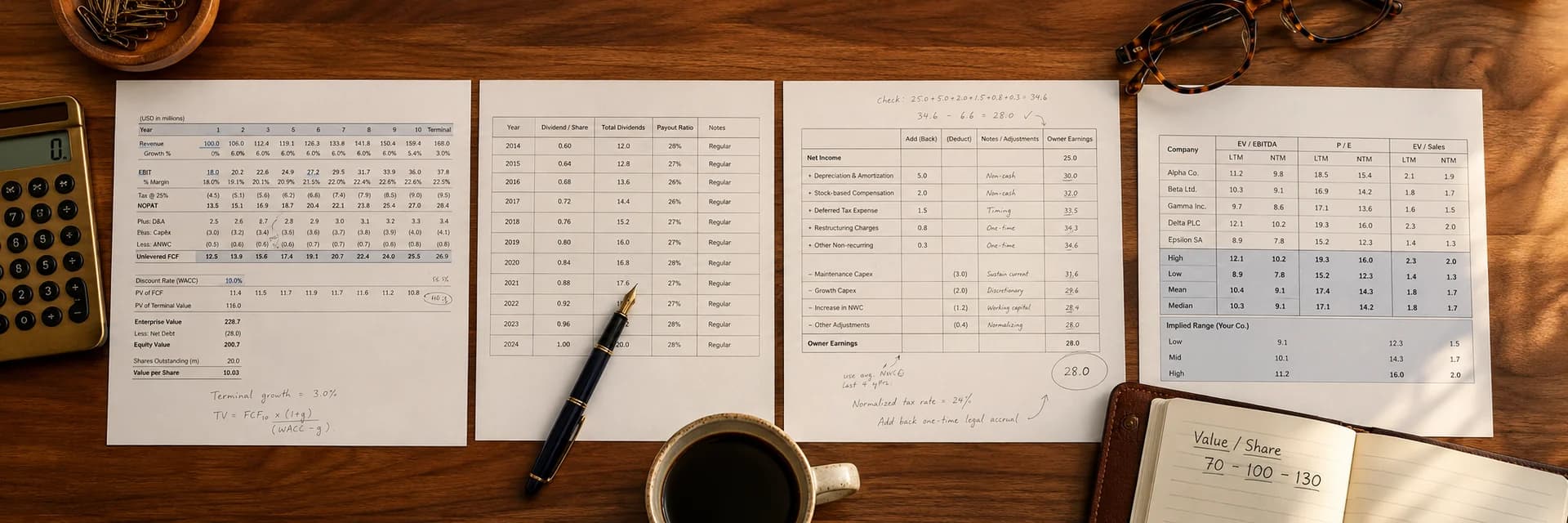
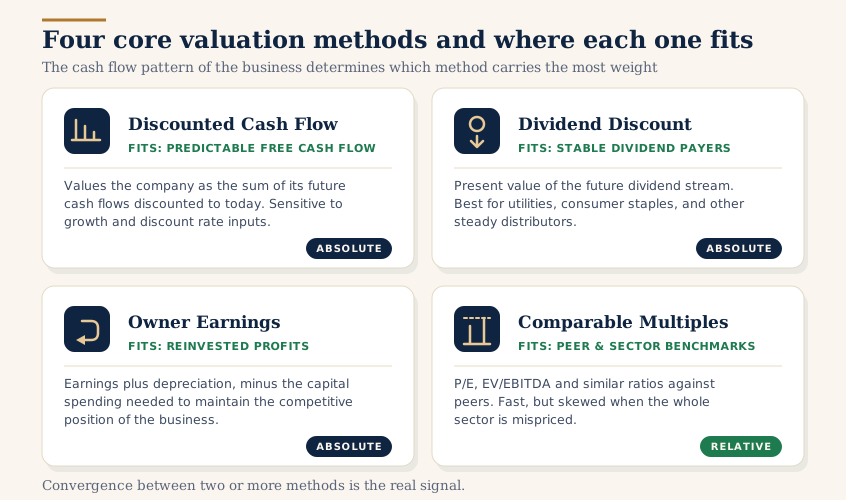
The four core stock valuation methods are discounted cash flow (DCF), the dividend discount model (DDM), owner earnings, and comparable multiples. DCF fits companies with predictable free cash flow; DDM fits stable dividend payers; owner earnings fits businesses that reinvest profits instead of distributing them; multiples benchmark a company against its sector. Disciplined analysts run more than one method, normalize the input data first, and express the result as a bear-base-bull range with a margin of safety rather than a single target price.
Introduction
Most investors focus entirely on price. They watch tickers scroll across a screen and react to green or red numbers. But price tells you only what you must pay to acquire a share. It tells you nothing about what that share is actually worth.
Stock valuation is the discipline of calculating the intrinsic value of a business regardless of its current market price. The sections below cover the primary methods used by serious investors, outline a repeatable workflow that reduces errors, and explain how to generate consistent reports.
The gap between paying a price and knowing a value is where most portfolio damage happens. An investor who cannot articulate what a business is worth has no basis for deciding whether a 20 percent drawdown is a buying opportunity or a warning sign. A documented valuation, built from normalized data and explicit assumptions, turns that decision from a mood into a checklist. It also leaves a written record: when a thesis breaks, you can see which specific assumption failed instead of guessing. Everything below serves that goal, from selecting the right method for the business in front of you through to the final written report. None of it requires institutional tooling; it requires consistency applied to public data.
What Stock Valuation Is (and Isn't)
Investment valuation is the process of estimating the theoretical value of a company based on its fundamental data. It uses cash flows, growth rates, and risk profiles to determine what a rational investor should pay for a share of the business.
This is distinct from price prediction. Price prediction attempts to guess where the market will move next week or next month based on sentiment or momentum. Valuation ignores the mood of the market. It focuses entirely on the economic engine of the company.
The intellectual lineage here is old and stable. John Burr Williams defined a stock's worth in 1938 as the present value of its future distributions, and Benjamin Graham built his career on the observation that price and value can diverge for years at a time. Modern practice keeps both ideas: value is a discounted stream of cash, and the market's job is to hand you prices, not verdicts. When the two disagree, the disagreement is the opportunity, provided your estimate is the careful one.
To understand this fully, you must grasp the difference between price vs value. Price is set by the auction of the stock market. Value is determined by the cash the business generates for its owners.
Core Investment Valuation Methods
No single formula works for every company. A stable utility company requires a different approach than a high-growth software firm. Advanced investors use a toolkit of methods to triangulate value, and the first analytical decision is matching the method to the business model.
Figure 1. Four core valuation methods and where each one fits
Method selection by business profile: the cash flow pattern of the company determines which valuation approach carries the most weight.
For a comprehensive educational overview of these core approaches, including DCF, EBITDA multiples, and margin of safety, see Education Valuations.
Discounted Cash Flow (DCF)
The DCF analysis is often considered the gold standard of absolute valuation. It relies on the principle that a company is worth the sum of all its future cash flows, discounted back to today's dollars.
This method forces you to think about the long-term health of the business. You must estimate:
-
Free Cash Flow (FCF): The cash left over after paying for operations and capital expenditures.
-
Growth Rate: How fast those cash flows will increase.
-
Discount Rate: The return you require to take on the risk of the investment.
The major risk with DCF is sensitivity. A small change in your growth assumption can double the estimated value. You should work through a detailed DCF inputs checklist before trusting any output; Aswath Damodaran's notes on estimating DCF inputs cover the academic grounding behind each assumption.
Dividend Discount and Owner Earnings
For companies that pay consistent dividends, the Dividend Discount Model (DDM) offers a simpler path. It values the stock based on the present value of future dividend payments. This is ideal for mature, stable industries like utilities or consumer staples.
For companies that reinvest their profits rather than paying dividends, Warren Buffett's concept of "Owner Earnings" is superior. He defined it in his 1986 letter to Berkshire Hathaway shareholders as reported earnings plus depreciation and amortization, minus the capital expenditures a business needs to maintain its competitive position and unit volume. The result is a closer reading of the cash actually available to owners than reported net income provides.
Comparable Multiples (Relative Valuation)
Relative valuation compares a company to its peers using ratios like Price-to-Earnings (P/E) or Enterprise Value-to-EBITDA. This is faster than a DCF but comes with risks. If the whole sector is overvalued, your comparison will be skewed. Choosing the right ratio for the right sector is its own discipline; the guide to industry benchmark multiples covers which multiples fit which industries and why.
Private market data often informs these multiples: the median private-company acquisition ran at about 7.5× EBITDA through mid-2024, up from roughly 6.5× in the pre-pandemic decade, a sign that buyers are paying more for control than they used to.
You must also be careful with simple ratios. Academic research finds that about 75% of the cross-sectional dispersion in P/E ratios is explained by expected future returns rather than earnings growth. A low P/E might not mean a stock is cheap. It often means the market expects low future returns or high risk.
The Valuation Workflow: From Data to Decision
Methodology is useless without a disciplined process. A haphazard approach leads to mistakes and emotional bias. Follow this workflow to keep your analysis honest.
Explore additional tools and workflow strategies for equity analysis at the Education hub.
1. Normalize the Data
Raw data from financial portals often contains noise. You might see a massive spike in earnings caused by a one-time asset sale. You must strip these out to see the recurring earnings power of the business. Understanding why valuation outputs differ across platforms starts with seeing how different providers clean (or fail to clean) this data.
Work from primary filings whenever a number looks unusual. The 10-K and 10-Q on SEC EDGAR carry the footnotes that explain one-time items; aggregated portal data frequently buries them. Key financial ratios, such as debt coverage or free cash flow, play a large role in this step. A practical reference on how these ratios support valuation and screening is available in Education Key Financial Ratios.
2. Build Defensible Assumptions
Garbage in, garbage out. Your model is only as good as your inputs. Do not just straight-line the past growth rate into the future.
-
Look at historical margins over a full economic cycle.
-
Assess the competitive landscape.
-
Be conservative with terminal value estimates.
Anchor the discount rate to observable data rather than intuition. The 10-year Treasury yield is the standard risk-free starting point; the equity risk premium and any company-specific risk go on top of it. If your discount rate ends up below what a Treasury bond pays, the model is broken, not the market.
3. Apply a Margin of Safety
Once you calculate a value, you must discount it further. The discount is a buffer against estimation error: your growth assumption, your discount rate, or your reading of the business will sometimes be wrong. If you calculate a stock is worth $100, you might only buy it at $70. This gap is your margin of safety. Treating margin of safety as an operational rule rather than a slogan limits the damage when your calculations miss the mark.
Output Discipline: Ranges Over Certainty
Novice investors want a specific number. They want a model to tell them a stock is worth exactly $142.50. Experienced investors know this is false precision.
Valuation is an estimate, not a physics equation. The future is uncertain. Therefore, your output should always be a range.
-
Bear Case: What is it worth if things go wrong?
-
Base Case: What is it worth if things go as expected?
-
Bull Case: What is it worth if the company executes perfectly?
Figure 2. Reading a bear-base-bull valuation range against the market price
The position of the current price inside (or outside) the estimated value range is the decision-relevant output, not any single point estimate.
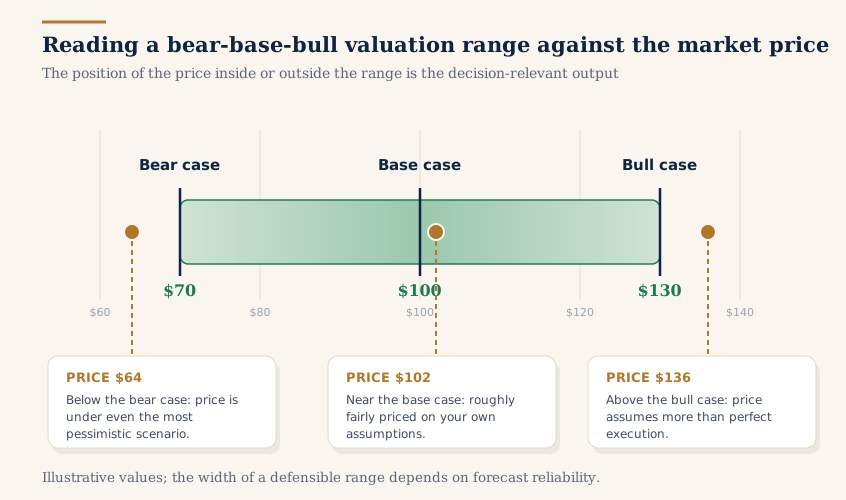
If the current price sits below your Bear Case, the market is already paying less than your most pessimistic scenario implies. If it sits above your Bull Case, the price assumes something better than perfect execution. Between those edges, the question becomes one of position sizing and patience rather than a binary verdict. Presenting your results as a range keeps you humble, makes your disagreement with the market explicit, and highlights the probability of different outcomes. The full framework for constructing and interpreting these ranges is covered in valuation ranges for fundamental analysis.
The screener-level comparison of price against a fair value estimate and the Investment Score gives the starting anchor; constructing the bear, base, and bull cases around any single estimate remains the analyst's discipline.
Using a Stock Valuation Report Generator
Consistency is critical. If you value one stock using a 3-page spreadsheet and another using a napkin, you cannot compare them effectively.
Despite the availability of advanced tools, spreadsheets remain the default workflow for many practitioners. Excel is flexible, but it is prone to broken formulas, silent copy-paste errors, and version-control drift, and no two analysts' sheets define their inputs the same way. The cost shows up exactly when consistency matters most: comparing two companies valued months apart.
Using a dedicated stock valuation report generator ensures that every company is judged by the same standards. A high-quality report must contain:
-
Source Data: Where the numbers came from.
-
Key Assumptions: Explicitly stated growth rates and discount rates.
-
Model Type: Whether it is a DCF, DDM, or multiple-based model.
-
Caveats: Risks that the model cannot capture (like regulatory changes).
If you would rather not maintain the model in a spreadsheet, the InvestViable Valuator runs the DCF calculation from three explicit inputs: the cash flow growth path, the discount rate, and the terminal growth rate. Keeping the inputs visible is the point; a valuation you cannot interrogate is a valuation you cannot trust. For details on the report workflow and subscription options, visit the Pricing page.
Common Valuation Pitfalls
Even with the best models, investors trip over psychological hurdles.
Regional Bias
Investors tend to focus only on their home markets, which shrinks the opportunity set and concentrates risk in a single economy and currency. The valuation discipline travels. Normalize foreign filings the way you would domestic ones, and demand the same margin of safety abroad that you demand at home. If you cannot read a market's disclosures well enough to normalize them, treat that as a data-quality problem to solve, not a detail to skip.
Confirmation Bias
This occurs when you decide you like a company first and then bend the inputs until the model agrees with you. If you find yourself lowering the discount rate just to make the valuation work, stop. You are no longer valuing the stock. You are justifying a purchase. The antidote is sequencing: lock your assumptions from historical data and competitive analysis before you let the model show you its output.
Double Counting
Be careful not to count the same benefit twice. For example, if you project high growth rates, you cannot also use a low discount rate. High growth usually requires high reinvestment and carries higher execution risk. The same trap appears in terminal values: a generous terminal growth assumption stacked on a generous explicit-period forecast compounds optimism rather than checking it.
For further learning and to access a community of professional valuation reports and peer insights, explore the Community platform.
How to apply this
Valuation is the bridge between speculation and investment. It requires you to dig into the fundamentals and standardize your workflow. It also requires accepting that the future is a range of possibilities. Start with the method that fits the business in front of you, normalize the data before modeling, and write the assumptions down where you can audit them later.
Use a consistent stock valuation report generator to document your assumptions and create a paper trail for your decisions. By focusing on the process rather than the price, you give yourself a documented basis for protecting capital instead of a feeling. Build your next valuation report in the InvestViable Valuator.
InvestViable does not publish buy or sell recommendations on individual securities. All analysis is based on public financial data and a transparent methodology. The Investment Score formula is proprietary; the inputs and what the score evaluates are documented.