
Valuation methods disagree because each method prices a different definition of value on a different set of assumptions. A discounted cash flow model prices a multi-year forecast, relative multiples price what the peer group currently trades for, and the Graham formula prices steady earnings against bond yields. To reconcile the outputs, restate them on identical per-share terms and translate each into the other's implied assumptions. Then locate the one or two inputs that carry the spread, weight the method that fits the company's economics, and report a range rather than an average.
Why valuation methods disagree on the same company
The three primary methods are often treated as three routes to the same destination, as if a careful enough analyst would land on one true number whichever road was taken. They are not. Each method answers a different question. A discounted cash flow model asks what a stream of future cash is worth today. A relative multiple asks what the market currently pays for a unit of similar economics. The Graham formula asks what a defensive investor would pay for this level of steady earnings while bond yields sit where they do. Three questions, three definitions of value, and no arithmetic reason for the answers to coincide.
This is the standard structure of the field, not a quirk. Aswath Damodaran's overview of valuation approaches separates intrinsic valuation, relative valuation, and asset-based valuation as distinct families resting on distinct premises. The full mechanics of the intrinsic side are covered in the DCF guide; the point here is what happens after you have run more than one family on the same business and the outputs refuse to line up.
It helps to be precise about which disagreement this article addresses, because there are two and they have different causes. When two platforms show different intrinsic values for the same ticker, the divergence usually lives in the data each platform fed its model: share counts, fiscal bases, adjustment policies. That is a data problem, and the cross-platform audit covers it. The disagreement here is the harder one: same analyst, same verified data, different methods, different answers. Nothing upstream is broken. The methods themselves are measuring different things, and the work is to extract the information the spread contains.
Three structural sources of disagreement
The spread between methods is not noise. It traces to three structural differences in how the methods are built, and knowing which one is operating tells you where to look when you reconcile.
The first is the assumption surface. A DCF carries the largest explicit assumption load: a cash flow growth path, a discount rate, and a terminal growth rate, each set by the analyst and each capable of moving the answer materially. A relative multiple compresses all of those assumptions into a single observed ratio. The assumptions have not disappeared; they have been delegated to the market, embedded in the price the peer group trades at. The Graham formula sits at the other extreme and hard-codes its structure: a base multiple for a no-growth company, a growth multiplier, and an adjustment for prevailing bond yields. Each method keeps its assumptions somewhere different: in your model, in the market's pricing, or in a fixed formula.
The second is market dependence. A multiple imports the peer group's current mood by construction, so when a sector re-rates, every multiple-based value in it moves, with no change in any company's economics. A DCF holds still in the same moment. Its anchor to capital markets runs through one input, the discount rate, typically built up from the 10-year Treasury yield. The Graham formula sits in between, tied to the level of bond yields but not to equity sentiment.
Figure 1. What each valuation method actually prices
The three method families compared on the definition of value, where their assumptions live, market dependence, and time treatment.
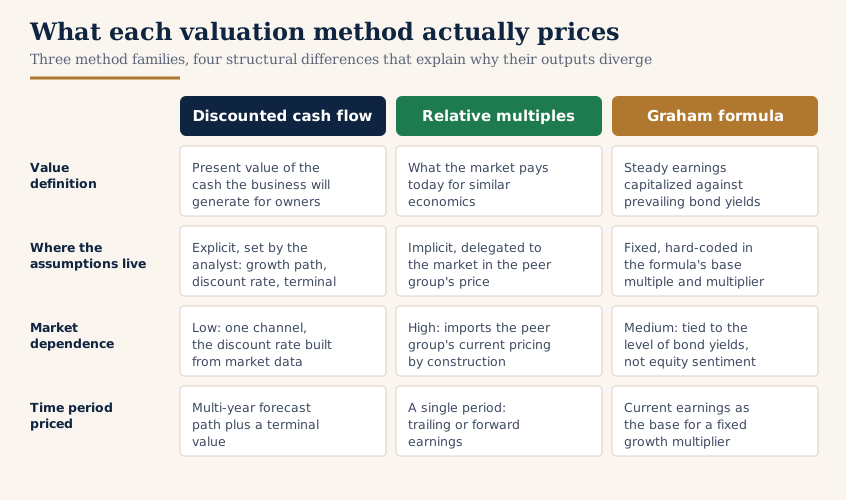
The third is time treatment. A multiple prices one period of earnings, trailing or forward. A DCF prices a decade-plus path, with most of the value usually sitting in the terminal years. The Graham formula anchors on current earnings as a representative base, then scales them by a fixed growth multiplier. For a stable business those three views of time describe the same company, and the outputs converge. For a cyclical business at the top of its cycle, the earnings-based outputs inflate while a DCF built on a normalized path stays lower, and the spread between them is the cycle, made visible.
Read the spread before you reconcile it
The size and direction of the disagreement is diagnostic, and reading it before adjusting anything keeps the reconciliation honest. Each pattern generates a specific hypothesis to test.
When the DCF sits well above the multiple-implied value, there are two candidate explanations, and both are testable. Either the forecast is optimistic, or the market is demanding a higher return from this peer group than your discount rate admits. The second explanation deserves more respect than it usually gets. Research on equity pricing finds that about 75% of the cross-sectional dispersion in price-to-earnings ratios reflects differences in expected returns rather than future earnings growth. A peer group trading at a low multiple is often pricing risk, not making an error your model has caught. The first input to re-examine is your own discount rate against the one the multiple implies.
When the Graham output sits above the DCF, the cause is usually time treatment: the current earnings the formula capitalizes are higher than the level your cash flow path treats as sustainable. That pattern is the classic signature of a cyclical company near a peak, and it argues for normalizing earnings before trusting any earnings-based output.
When the multiple-implied value sits above the DCF in a sector that has been rising, the likely driver is re-rating: the peer group has been repriced, and the multiple is faithfully importing that repricing into your valuation. The question to ask is whether anything in the companies' cash generation changed, or only the price the market pays for it.
And when all the outputs land in a tight band, treat the convergence as the meaningful signal it is. It tends to happen for stable, profitable, moderately growing businesses, exactly where every method's assumptions hold simultaneously. The discipline across all four patterns is the same: write the hypothesis down before touching a single input, so the spread directs the investigation rather than the conclusion directing the spread.
How to reconcile valuation methods: bridge the gap input by input
Reconciliation is a verification exercise, not an act of judgment by committee. The workflow runs in four steps, each producing something checkable.
Step one is hygiene. Restate every output on identical per-share terms: the same diluted share count, the same net debt, the same earnings basis. A surprising share of apparent method disagreement is actually definitional drift between calculations, the same failure mode that drives cross-platform divergence. Pull the figures from the company's filings on SEC EDGAR rather than from summaries, so every method consumes the same verified inputs.
Step two is translation. Convert each output into the other's native terms. Divide the DCF's per-share value by earnings per share on the same diluted basis (or, equivalently, total equity value by net income), and you have the price-to-earnings ratio your model implies. Set it next to the peer multiple, and the abstract disagreement becomes a concrete gap between two ratios. Run the translation in the other direction too: ask what growth rate the peer multiple implies if you hold your discount rate fixed, and judge whether that implied path is one the business can plausibly deliver. This is the logic of a reverse DCF applied as a reconciliation tool.
Figure 2. Bridging a DCF value to a multiple-implied value
A worked bridge decomposing the spread between two method outputs into the specific assumptions that carry it.
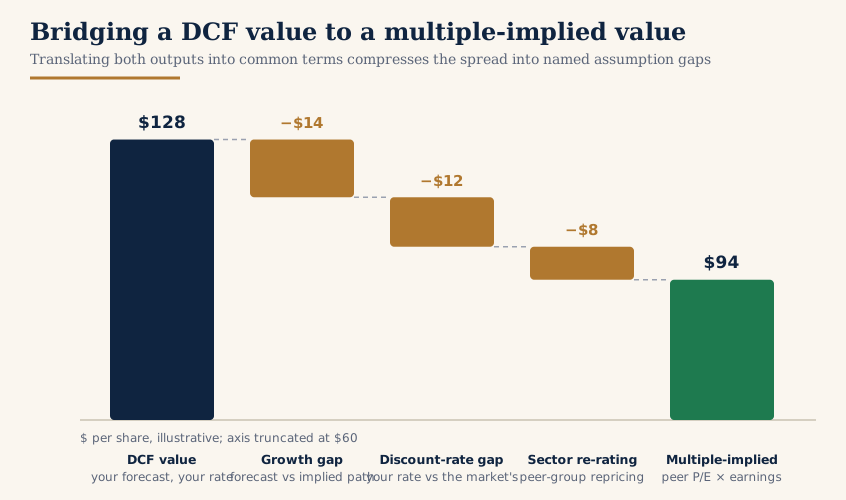
Step three is isolation. The translated gap usually compresses into one or two inputs, most often the growth path or the discount rate. Verify those few inputs against current data rather than nudging outputs toward each other: rebuild the discount rate from its components, and check the equity risk premium against Damodaran's current implied premium estimates rather than carrying a figure from an older model. The DCF inputs checklist covers this verification pass input by input.
Step four is acceptance. Fix what the verification shows to be wrong, then stop. Whatever disagreement survives an honest bridge is information about genuine uncertainty, and the right place for it is the width of your valuation range, not a forced consensus.
Why averaging valuation methods fails
The tempting move, once three methods produce three numbers, is to average them. It feels balanced and it is almost always wrong, because averaging treats the outputs as independent estimates of the same quantity. They are not. One is a forecast-based value, one is a market-sentiment-based value, and one is a formula calibrated to a different era's bond market. The midpoint of three different definitions of value has no economic meaning of its own.
Averaging also launders known errors into respectable-looking numbers. If the diagnostic pass has already shown the Graham output to be inflated by peak-cycle earnings, including it in an average imports a known distortion at one-third weight, weakening the estimate precisely after you found the problem. An average is only as honest as its least defensible component, and it hides which component that is.
The defensible alternative is weighting by fit, decided before seeing which weighting flatters the conclusion. Lead with the method whose core assumption the company actually satisfies. A predictable cash generator earns a DCF lead; a company priced mainly against a well-defined peer group earns a multiples lead; a stable moderate grower tolerates the Graham formula as a cross-check. The non-lead methods are not discarded; they become corroboration and contradiction, the evidence that sets the boundaries of the estimate. The verified spread between them, after the bridge work is done, defines a valuation range that carries more information than any single number. Its width is an honest measure of how much the methods had to assume.
Where reconciliation fits in your workflow
The sequence that makes the spread useful runs end to end. Verify the data once, then run the two or three methods the company's economics support on those identical inputs. Read the direction of the spread and bridge it input by input. Fix what verification proves wrong, and let the residual disagreement set the width of the range. The final step is calibration. The wider the reconciled range stays, the larger the margin of safety the position has to clear, because a wide residual spread is the methods telling you how much the valuation depends on assumptions that could not be verified either way.
Keeping the DCF side of the bridge auditable is most of the practical work, and it is where tooling helps. The InvestViable Valuator exposes its core inputs directly: the cash flow growth path, the discount rate, and the terminal growth rate. The implied-multiple translation in step two then starts from assumptions you can read directly rather than reverse-engineer from a finished number. A valuation built on visible inputs is one you can bridge; a black-box number can only be argued with.
InvestViable does not publish buy or sell recommendations on individual securities. All analysis is based on public financial data and a transparent methodology. The Investment Score formula is proprietary; the inputs and what the score evaluates are documented.