
The Investment Score runs 28 checks grouped into three categories: Valuation, with a maximum of 8 points; Financial Strength, with a maximum of 10; and Performance, with a maximum of 13. Those maximums sum to a fixed denominator of 31 points, which is then scaled to a capped 0-100 reading and mapped onto five bands from Weak to Excellent. Most checks are pass or fail; a few use a three-tier scale. The Score is a backward-looking summary of reported fundamentals, not a forecast and not a buy or sell recommendation. It works best as the first filter in a process that ends with your own valuation.
Why a transparent score beats a black box
A quality score is only as useful as the disclosure behind it. When a rating hides its inputs, you cannot tell whether it weights what you weight or leans on a metric you distrust. You also cannot tell whether a low reading reflects genuine weakness or just a quirk of the formula. That opacity is the same problem that undermines opaque price targets, where a precise-looking figure conceals the assumptions doing the real work. The discipline of auditing analyst targets rather than trusting them applies just as well to any composite score: a number you cannot interrogate is a number you cannot rely on.
Rule-based fundamental scoring has a long academic and practitioner lineage precisely because transparency makes it testable. A composite that states its components can be checked, criticized, and improved, whereas a proprietary verdict cannot. Aswath Damodaran argues that the value of any scoring or valuation approach lies in making the reasoning explicit rather than defending a single authoritative output. The Investment Score is built on that principle. The exact thresholds and weights inside each check are proprietary. What is published is the structure: how many checks there are, how they group, what each category broadly tests, and how the points become a score. That category-level transparency is enough to read the result intelligently without handing the full methodology to anyone with a spreadsheet.
What the Investment Score evaluates: 28 checks across three categories
The Investment Score runs 28 checks across three categories, each measuring a different dimension of fundamental health. Valuation asks whether the current price is reasonable against the company's own economics. Financial Strength asks whether the balance sheet can withstand stress. Performance asks whether the business is actually growing and earning a return on the capital it uses. The categories carry different weights by design, reflected in their maximum point contributions.
Figure 1. The three Investment Score categories and their point maxima
Each category contributes a fixed maximum; the three sum to a 31-point denominator before scaling.
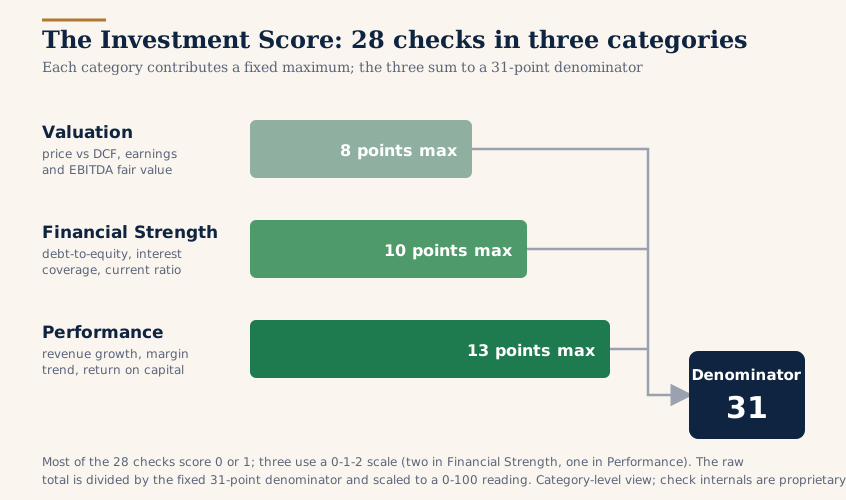
Within each category, the checks are concrete fundamental tests rather than abstract judgments. Valuation checks compare the price to several independent fair-value estimates, so a stock does not look cheap or expensive on the strength of one method alone. The three the platform surfaces are DCF, Earnings Fair Value (the Graham-inspired earnings method), and the EBITDA Multiple. Financial Strength checks examine the balance sheet through measures such as debt-to-equity, interest coverage, and the current ratio, the same structural-survival questions that a manual solvency review works through by hand. Performance checks look at whether revenue is growing, whether margins are holding or improving, and whether the company earns an adequate return on the capital it deploys. These are illustrative of what each category tests. The published methodology stays at this level rather than naming all 28 checks, because the specific tests and their cutoffs are the part of the system worth protecting.
How 28 checks become a 0-100 score
The arithmetic that turns 28 checks into one number is deliberately simple, because comparability matters more than cleverness. Most of the checks are binary: a company either clears the test and earns a point or it does not. A small number, three of the 28, use a three-tier scale that can award zero, one, or two points. That allows a little more gradation where a pass-or-fail answer would be too blunt. Two of those graduated checks sit in Financial Strength and one sits in Performance. Stated at this level, you know the shape of the scoring without needing the internal rules of any single check.
Add the points a company earns across all three categories and the maximum possible total is 31. That figure is the fixed denominator of 31 points, and it is the quiet design decision that makes the whole system work. Rather than re-base the score whenever data is sparse, the denominator stays constant. When a check cannot be evaluated, most often because a company has not reported the figure it needs, that check scores zero and the denominator remains 31. The raw total is then divided by 31 and scaled to a 0-100 reading that is capped at 100, so no company can exceed the top of the range.
Holding the denominator fixed is what keeps scores honest across a universe of thousands of companies. Suppose the denominator shrank every time a figure was missing. A data-poor company could then post an artificially high score on the handful of checks it happened to pass. The number would no longer mean the same thing from one stock to the next. The fixed-31 rule trades a little leniency for a lot of consistency: every company is measured against the same yardstick. That is the entire point of a score meant for ranking and comparison.
How to read the five interpretation bands
A 0-100 number invites false precision, so the Investment Score groups the range into five interpretation bands. These are the only bands Invest Viable publishes for reading the score, and they exist to stop investors from over-interpreting the gap between, say, a 67 and a 69.
Figure 2. The five interpretation bands on a 0-100 scale
A band frames how much review a company warrants; it is not a verdict on the stock.
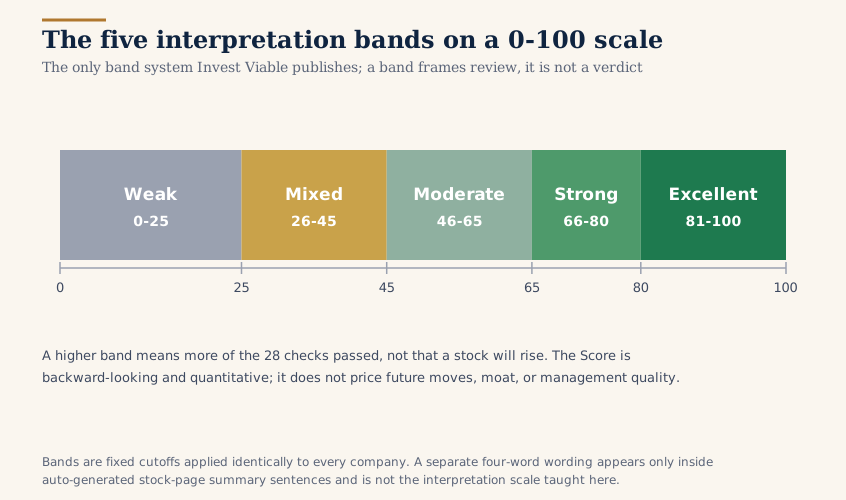
Read the band as a triage signal. A Weak or Mixed reading says the company fails a meaningful share of the structural tests, which is a reason to either pass quickly or understand precisely why before going further. A Moderate reading is genuinely mixed: some dimensions are healthy and others are not, and the category totals tell you which. Strong and Excellent readings indicate that the fundamentals currently clear most of the checks, which earns a company a closer look, not an automatic place in a portfolio. The most common mistake is to treat a single high number as the conclusion of the analysis when it is really the beginning. Drilling into the three category totals beneath the headline figure reveals the shape of the result. A company can reach a Strong overall band on excellent Performance and Financial Strength while its Valuation category is weak. That is a very different situation from one that scores evenly across all three.
A separate four-word wording sometimes appears inside the auto-generated summary sentence on an individual stock page. That phrasing is not the interpretation scale, and it should not be used to read the score. The five bands above are the system to teach and to rely on.
What the Investment Score deliberately does not measure
Understanding a score's blind spots is as important as understanding its mechanics. The Investment Score is backward-looking and quantitative by construction. It summarizes what a company's reported fundamentals already show; it does not predict where the share price is going, and it makes no claim to. Four things in particular sit outside its scope. It does not measure management quality, because integrity and capital-allocation skill do not reduce to a reported ratio. It does not measure the competitive moat, because the durability of an advantage is a judgment about the future rather than a fact in the filings. It does not price macroeconomic risk, such as the level of interest rates captured by the 10-year Treasury yield. That shifts the value of every business but appears nowhere in a single company's accounts. And it does not, on its own, tell you whether the current price is a bargain.
That last point deserves emphasis, because a strong Valuation category can be misread as a buy signal. A low valuation reading often reflects risk the market has already recognized rather than an opportunity it has missed. Research on equity pricing finds that most of the dispersion in price-to-earnings ratios reflects differences in expected future returns rather than differences in future earnings growth. A low reading, in other words, frequently encodes a higher required return for risk the market already sees. The Score can flag that a stock screens cheap on its checks; it cannot tell you whether cheap is justified. This is why the Investment Score is explicitly not a buy or sell recommendation and why it complements, rather than replaces, qualitative work. The structured tests it automates are necessary, but the judgment about durability, management, and price is the part of investing that no score can do for you.
Where the Investment Score fits in a research process
The Investment Score earns its keep at the front of a workflow, where its job is to compress a universe of thousands of companies into a shortlist worth deeper attention. Used as a screen, it ranks the field so your limited hours go to the names most likely to reward them. Within the InvestViable stock screener, the score is one filter among many. Paired with a style screen, such as the value style, it surfaces statistically cheap companies while holding them to a quality floor. That floor is what keeps a price-only filter from flooding the list with value traps. The score does the first cut. It does not make the decision.
After the shortlist comes the work the score cannot do. Verify the fundamentals behind the number, because a score inherits any error in its inputs. The discipline of sanity-checking fundamentals against primary filings on SEC EDGAR keeps a clean-looking score from resting on a misreported figure. Then run an independent valuation to judge whether the price is reasonable, because a high Performance and Financial Strength reading says nothing about what you should pay. Finally, apply a margin of safety scaled to how much confidence the analysis actually supports. The score sets the agenda for this work; it is the structured, repeatable layer that frees you to spend judgment where judgment is required.
How to apply this
Start by reading the Investment Score the way it is built to be read. Look at the band first, then the three category totals, then the underlying fundamentals, in that order of resolution. The band tells you how much attention a company warrants. The category totals tell you where its strengths and weaknesses sit, which is far more useful than the headline number for deciding what to investigate. From there the score hands off to the rest of the process. Confirm the inputs against the filings, build your own view of value, and decide on a price independently of the score. The score measures fundamentals, not whether the market has priced them sensibly.
Above all, treat the Investment Score as a triage tool rather than a verdict. Its strength is consistency: 28 checks applied identically to every company, rolled into a comparable 0-100 figure with a fixed 31-point denominator behind it and five published bands in front of it. That consistency is exactly why it belongs at the start of the funnel and not at the end. A score narrows the field honestly and quickly; the work of deciding what a business is worth, and what you are willing to pay for it, stays where it should, with you.
InvestViable does not publish buy or sell recommendations on individual securities. All analysis is based on public financial data and a transparent methodology. The Investment Score formula is proprietary; the inputs and what the score evaluates are documented.