
InvestViable does not publish buy or sell recommendations on individual securities. All analysis is based on public financial data and a transparent methodology. The Investment Score formula is proprietary; the inputs and what the score evaluates are documented.
What investment research platforms claim, and what the analyst needs
A platform's marketing page is organized around attributes that fit into a comparison grid: universe coverage, pricing freshness, watchlist capacity, and increasingly a language-model assistant. These attributes are easy to count and easy to differentiate, which is exactly why they dominate the page. The attributes the analyst is actually paying for sit one layer down, in how the platform sources its data, how its screens handle messy issuers, and how its valuation outputs are constructed. A trial spent admiring the grid ends with an impression of polish; a trial spent probing the layer underneath ends with an assessment.
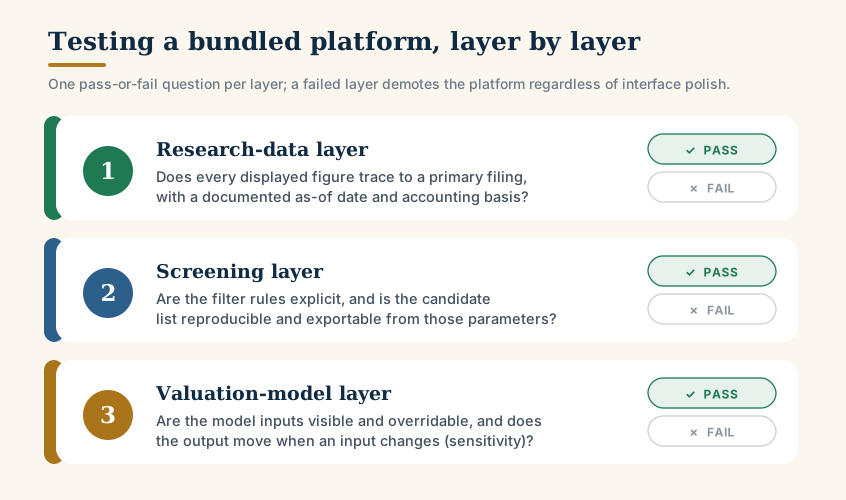
A bundled platform sells three functional layers behind one subscription. The first is the research-data layer, which displays the fundamentals every downstream feature depends on. The second is the screening layer, which narrows the listed universe to a working candidate list. The third is the valuation layer, which converts a candidate's figures into an estimate of what the business is worth. Each layer answers a different question and fails in a different way, so the trial tests each one separately rather than scoring the platform as a single undifferentiated product. The sections that follow take the three layers in the order the data depends on them, because a weakness in one layer changes what the layers below it are worth.
Figure 1. The three layers a bundled platform sells, and the one question each must answer
A trial tests each layer with a single pass-or-fail question rather than scoring the platform as one product. A layer that fails its question demotes the platform regardless of interface quality.
The equity research tools layer: data, transparency, documentation
The equity research tools a platform bundles are only as good as the data underneath them, so the first trial check is whether the platform's displayed fundamentals are anchored in the filing record. Every headline figure should trace back to a specific line item on a specific filing, with a documented as-of date and a documented basis of audited figures versus pre-filing estimates. For domestic issuers the primary source is the 10-K or 10-Q on SEC EDGAR; for foreign private issuers, the 20-F. The trial test is to pick three tickers, open the platform's fundamentals view beside the filing, and confirm the numbers match and the platform tells you where they came from.
Transparency about accounting basis is the second check at this layer. The gap between audited figures and management-defined adjusted figures can move an operating margin by several percentage points, because adjusted measures commonly exclude stock-based compensation, restructuring charges, and amortization of acquired intangibles. A platform that displays a single operating-margin number without disclosing whether it is the reported or the adjusted version has failed the transparency check; the figure cannot be interpreted without knowing which basis produced it. The deeper, line-by-line version of this audit, applied after a platform is already in your workflow, is documented in the six checks for evaluating stock analysis websites; during a trial, the lighter three-ticker trace is enough to decide whether the data layer clears the bar.
Documentation is the third check. A platform that exposes its figures but documents neither their sources nor their refresh cadence leaves the analyst unable to judge how stale a number is allowed to become. The trial question is simple: can you find, inside the trial period and without contacting support, a written description of where each fundamentals figure originates and how often it updates? If the answer requires a sales call, the documentation has failed the test, and the other two layers inherit the uncertainty.
The stock screening tools layer: filters, normalization, export
The stock screening tools a platform offers are the second layer to test, and the test is whether the screen is a reproducible rule or an opaque ranking. A defensible screen lets you specify the filter criteria, see exactly which thresholds were applied, and reproduce the same candidate list from the same parameters on a later day. A screen that returns a curated list without exposing the rule behind it is an opaque ranking in disguise, and an opaque ranking cannot be audited against your own thesis.
Filter expressiveness is the first screening check. The screen should support multi-criteria queries across financial structure, valuation level, sector, capitalization, and style, and it should handle the edge cases that break naive screens: dual-class shares with different voting rights, recently spun-off entities with limited history, foreign private issuers reporting under non-domestic frameworks, and special-purpose acquisition companies that report against trust assets rather than operating fundamentals. The trial test is to run a screen that deliberately includes one of these edge cases and check whether the platform treats it correctly or silently mishandles it. A rule-based stock screener whose output is reproducible from its parameters passes; a black-box ranking does not.
Normalization and export are the second and third screening checks. Normalization asks whether the screen filters on a consistent accounting basis across issuers, because a value screen that compares reported margins for one company against adjusted margins for another is filtering on noise. Export asks whether you can pull the candidate list out of the platform into your own working file, because a candidate list locked inside the platform cannot feed the verification and valuation steps that follow. The reason platform-to-platform screens disagree on the same criteria is documented in why valuation outputs differ across platforms; during a trial, the practical point is that a screen you cannot reproduce or export is a screen you cannot build a workflow on.
The valuation model layer: inputs, sensitivity, audit trail
The valuation model is the layer where a platform makes its boldest analytical claim, displaying a single number for what a business is worth, so it deserves the most demanding trial test. The first check is input visibility. The model should let you see the cash flow growth path it applied, the discount rate it applied, and the terminal growth rate it applied, and it should let you change each one and watch the output move. A model that prints a fair-value figure without exposing the assumptions behind it is asking for inherited trust; a model that exposes and accepts overrides on its assumptions is an instrument you can interrogate. Aswath Damodaran's published valuation work treats input transparency as a precondition for any defensible intrinsic-value estimate, and the trial is where you confirm the platform meets it.
Sensitivity is the second check. Terminal value typically accounts for the majority of a discounted cash flow output, so a small change in the terminal growth rate or the discount rate reshapes the entire estimate. The current 10-year Treasury yield published by FRED anchors the risk-free component of that discount rate, and a credible model lets you see how the output responds when the rate moves. The trial test is to shift one input by a plausible amount and confirm the platform shows the effect rather than hiding it behind a static number. A model whose output does not visibly respond to its own inputs is concealing where its conclusion comes from.
The audit trail is the third check. The investor should be able to drill from the displayed output back to the inputs that produced it; without that chain, disagreement is impossible. As one example of an exposed chain, the InvestViable Valuator surfaces three forward-looking inputs the user can override directly on the displayed intrinsic value: the cash flow growth path, the discount rate, and the terminal growth rate. The wider principle applies to any platform: a valuation output you can trace and override is an analytical input, and one you cannot is a conclusion you are being asked to accept. The verification questions to run against each input category are catalogued in the DCF inputs checklist.
A seven-step trial test that avoids trial fatigue
Trial fatigue is the failure mode this method exists to prevent. An investor opens the trial, clicks through features without a plan, and reaches the deadline with an impression shaped by interface polish rather than an assessment shaped by evidence. The fix is to fix the questions before the trial starts and run them in a fixed order, so the trial becomes a finite sequence of checks with a defined endpoint.
Figure 2. The seven-step platform trial test, time-boxed
A linear protocol run once per platform inside the trial window. Each step has a pass-or-fail outcome; a failed step at the data layer can stop the test before the later steps run.
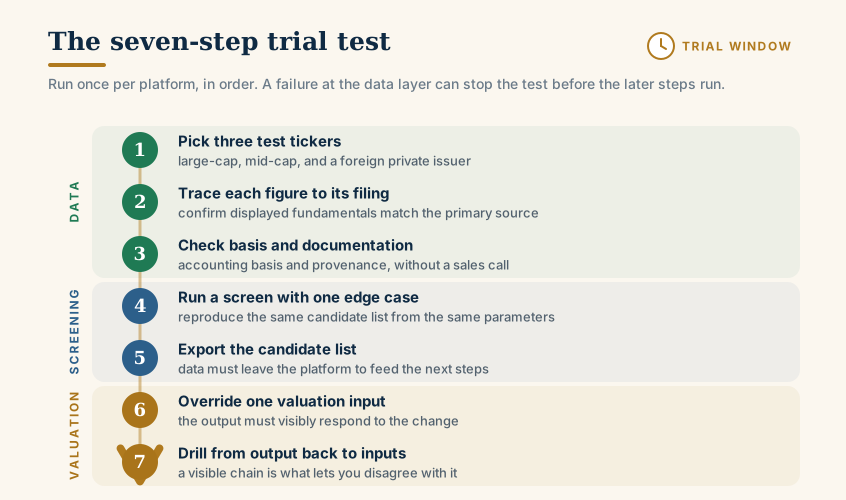
The protocol runs in seven steps. First, pick three test tickers that stress different parts of the platform: a large-cap domestic issuer, a mid-cap, and a foreign private issuer reporting under a non-domestic framework. Second, trace each platform-displayed fundamentals figure for those tickers back to the primary filing, confirming the numbers match. Third, confirm the platform discloses the accounting basis and the source documentation without a sales call. Fourth, run a screen that deliberately includes one edge case, such as a dual-class issuer, and reproduce the same candidate list from the same parameters. Fifth, export that candidate list to a working file outside the platform. Sixth, open the valuation model on one candidate, override a single input, and confirm the output responds. Seventh, drill from a displayed output back to the inputs that produced it.
The scoring is pass-or-fail per step, not a weighted average, because the layers depend on each other in sequence. A platform that fails the data trace at step two does not earn back the failure with an elegant valuation interface at step six, since the elegant valuation is being computed on figures that were never verified. A platform that passes all seven steps has demonstrated that its three layers are auditable, which is the property that lets its outputs feed a workflow. The same layered separation, expanded into a standing toolkit rather than a one-time trial, is the subject of the valuation-first stocks tools stack; the trial test is how a candidate platform earns a slot in that stack.
Red flags that should end a trial, and where the decision fits
Some trial findings are not slow accumulations of doubt but single disqualifying signals. A platform that cannot show where a headline number came from has failed the layer the other two depend on, and no downstream feature compensates. A valuation output that does not move when its inputs change is concealing its own construction. A screen that returns a list without exposing the rule behind it is issuing verdicts the analyst cannot audit. A documentation set that requires a sales conversation to answer basic provenance questions is a structural choice, not an oversight. Any one of these ends the trial with a decision, which is a more useful outcome than a vague sense that the platform felt limited.
Incentive structure is the red flag easiest to miss inside a polished trial. If a platform earns revenue from the issuers it covers, or from order flow generated when users act on its signals, its economic interest may not align with the holding-period horizon of a long-term investor. The disclosure of these arrangements belongs at the per-output level, not buried in a terms-of-service document, and the CFA Institute standards on research independence describe what adequate disclosure looks like. A trial is the right moment to read how a platform makes its money, because the answer shapes how much weight its conclusions can carry.
The trial decision sits upstream of the analytical work, not inside it. A platform that passes earns a defined role in the workflow as a universe filter, a fundamentals reference, or a first-pass valuation engine; a platform that fails still supplies lead-generation ideas, provided those ideas get verified elsewhere before they influence a position. Once a platform is in the workflow, the discipline shifts to the business itself: the safety checklist for analyzing stocks disqualifies structurally flawed issuers, and the broader methodology behind the Invest Viable approach is documented on the about page. A su