
Valuing a stock with the EV/EBITDA multiple means estimating enterprise value as normalized EBITDA times a multiple, then bridging that enterprise value back to a per-share equity value. Use enterprise value because it is neutral to how the company is financed. Choose the multiple by building a tight peer set. Then judge where the company belongs in that range, based on its growth, margins, capital intensity, and risk, instead of defaulting to the sector median. Normalize EBITDA first, express the result as a range, and treat the method with suspicion for capital-heavy, lease-heavy, or money-losing businesses.
What the EV/EBITDA multiple actually measures
EBITDA multiple valuation rests on a simple idea. The market value of a whole business should bear a sensible relationship to the operating earnings it produces. EBITDA, earnings before interest, taxes, depreciation, and amortization, is a rough proxy for the pre-financing, pre-tax cash a company generates from operations. Put enterprise value over EBITDA and you get a ratio that measures the firm's value against operating earnings. As Aswath Damodaran notes in his lecture notes on value multiples, that differs from a price-to-earnings ratio, which sets the value of equity against equity earnings.
EV/EBITDA
The ratio of enterprise value (the value of the whole business, debt and equity combined) to earnings before interest, taxes, depreciation, and amortization. It expresses how many dollars of total firm value the market assigns to each dollar of operating earnings.
The number is not arbitrary. Every multiple is a compressed valuation. Embedded inside it are the same forces that drive any discounted cash flow model: expected growth, the cost of capital, the tax rate, and the reinvestment needed to keep growing. A high EV/EBITDA is the market's shorthand for strong growth, low risk, or light reinvestment. A low one is shorthand for the opposite. So a multiple and a full DCF valuation are not rival camps. They are two views of the same economics, and the multiple is the faster, coarser one. Treating the multiple as a black box, instead of a stand-in for those drivers, is where most misvaluations begin.
Why enterprise value, not the share price
Enterprise value in the numerator is what gives this multiple its edge over a price-to-earnings ratio. EBITDA sits above the interest line, so it measures earnings before financing decisions touch them. To compare like with like, the numerator must cover the same scope: the whole capital structure, not just the equity slice. Enterprise value does exactly that. Because it nets out financing, EV/EBITDA compares firms with very different leverage. It can even be computed for a company reporting a net loss, since operating earnings before depreciation can still be positive.
A price-to-earnings ratio cannot make either claim. Two companies with identical operations but different debt loads show different P/E ratios, purely because interest expense and share counts differ. The EV/EBITDA pair neutralizes that distortion. That is why it is the standard multiple for comparing operating businesses and for screening acquisition candidates.
Figure 1. From an EV/EBITDA multiple to a per-share value
The multiple values the whole firm; reaching a share price means walking back across the capital structure to the equity that shareholders actually own.
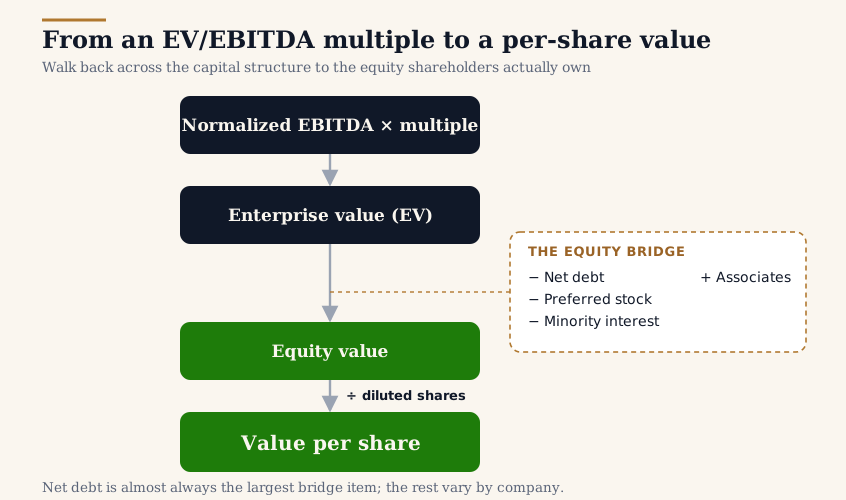
Enterprise value is built from the market capitalization plus total debt, preferred stock, and minority interest. From that you subtract cash, equivalents, and any stakes in associates, which are non-operating items. The cash adjustment carries a consistency rule worth remembering. If you net cash out of the numerator, do not leave the interest income it earns inside EBITDA, or the two sides of the ratio stop matching. Choosing EV/EBITDA over P/E is one decision inside the larger question of which valuation method to use. The multiple earns its place whenever capital structures differ across the peer group.
How to choose the right EV/EBITDA multiple
This is the decision that does the real work, and here a framework matters more than a formula. The first choice is trailing versus forward EBITDA. A trailing multiple uses the last twelve months of reported earnings and is harder to game. A forward multiple uses next year's estimate and fits better when earnings are growing or recovering predictably. Use forward EBITDA only when the forecast is defensible, and disclose which basis you are on. A company looks far cheaper on a forward number that may never arrive.
The second choice is the peer set. A tight group of companies with similar economics beats a broad sector list every time, because a multiple inherits the traits of whatever you compare against. For the sector-level benchmarks that anchor a peer range, the guide to valuation multiples by sector shows where EV/EBITDA sits across major industries. That data is the starting context. The peer set narrows it to the handful of businesses that actually resemble the one you are valuing.
Figure 2. Anchoring a company's multiple within its peer range
The peer set defines the range; the company's own characteristics decide whether it deserves a multiple above, at, or below the median.
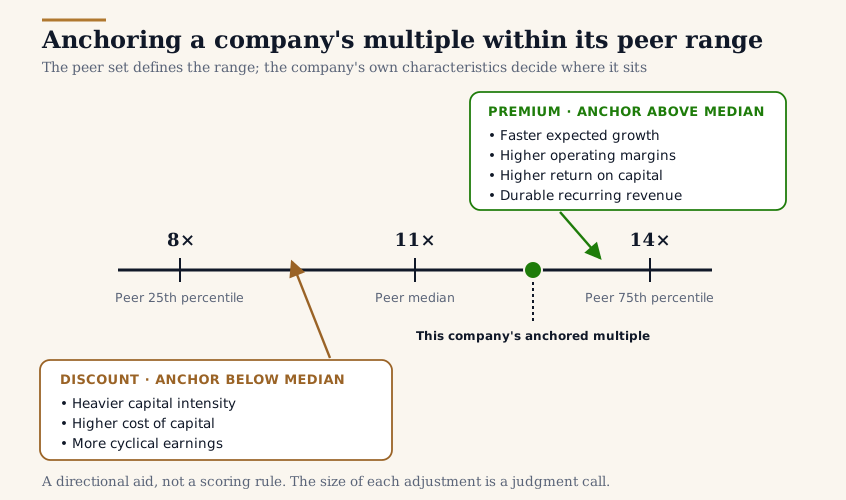
The third and hardest choice is where to anchor the company within the peer range. Defaulting to the median is the most common mistake. It assumes the company is average on every dimension that drives value, and it rarely is. Damodaran's work on the determinants of value multiples shows what should move the anchor. A business warrants a premium to peers on faster expected growth, higher margins, higher return on capital, or more durable recurring revenue. Heavier capital intensity, a higher cost of capital, or more cyclical profits argue for a discount. Picking the multiple is an act of judgment about how the company compares with peers, on the same variables a DCF would weigh. Get that comparison right and the arithmetic that follows is trivial.
Normalize EBITDA before you apply a multiple
The multiple magnifies every dollar in the base figure. So the EBITDA you multiply has to reflect sustainable operations, not an accident of the trailing year. Normalizing means removing one-time items such as restructuring charges or litigation settlements. It also means adding back above-market owner compensation in a founder-led business, and excluding non-recurring revenue. An EBITDA overstated by ten percent produces a valuation overstated by about ten percent. The work here is not housekeeping. It sets the accuracy ceiling for everything downstream.
Company-reported adjusted EBITDA deserves particular scrutiny. Management has discretion over what counts as an adjustment, and the temptation is to add back costs that are in fact recurring. Stock-based compensation is the classic example. It is a genuine economic cost that dilutes shareholders, yet it is routinely added back to flatter the headline figure. Securities regulators police this directly. The U.S. Securities and Exchange Commission's guidance on non-GAAP financial measures requires issuers to reconcile any adjusted figure to the most comparable reported number. It also prohibits presentations that mislead. Copy that discipline. When you accept an adjusted EBITDA, know exactly what was added back, and decide for yourself whether each item belongs out.
Lease accounting is a second comparability trap. Under IFRS 16, most operating leases now sit on the balance sheet. That moves the lease cost out of operating expenses and into depreciation and interest. The mechanical effect is to lift reported EBITDA, sometimes materially for retailers, airlines, and other lease-heavy businesses. A company can show an EBITDA jump that reflects accounting rather than operations, especially across the year of adoption. When your peer set spans different reporting regimes, adjust for the lease treatment before you trust the multiple.
From the multiple to a per-share value
Once you have a normalized EBITDA and a chosen multiple, the calculation runs in three steps. The figures below are illustrative round numbers, not a specific company. Suppose a business generates normalized EBITDA of $500 million, and your peer analysis supports an 11x multiple. Enterprise value is $500 million times 11, or $5.5 billion. From there you walk back to equity. Subtract net debt of, say, $1.5 billion, plus any preferred stock and minority interest (this business carries neither). Add back stakes in associates (also none here). That leaves an equity value of $4.0 billion. Divide by 200 million diluted shares and the result is $20 per share. That is what the method says the equity is worth, if the multiple is right.
Enterprise value      = Normalized EBITDA × multiple
Equity value          = EV − net debt − preferred − minority interest + associates
Value per share       = Equity value ÷ diluted shares
The single point hides more uncertainty than it shows, so the honest output is a range, not a number. Run the bridge with a conservative, central, and optimistic multiple, and you get a bear, base, and bull estimate. Building and reading those valuation ranges as a spread keeps the uncertainty visible. On InvestViable, every stock page shows an EBITDA Multiple estimate as one of three base valuations, beside DCF and Earnings Fair Value, so a multiple-based figure never stands alone. For the cash-flow side, the InvestViable Valuator builds the DCF from three explicit inputs: the cash flow growth path, the discount rate, and the terminal growth rate. Every assumption is user-controlled. Where the verdict matters, cross-check the multiple against a DCF, and apply a margin of safety scaled to how much the analysis had to assume.
Where the EV/EBITDA multiple breaks
The most important thing to know about a tool is where it fails, and EV/EBITDA fails in predictable places. Its defining weakness is that it ignores capital intensity. EBITDA sits above depreciation, so it says nothing about the reinvestment a business needs to maintain its asset base. A capital-heavy manufacturer and a capital-light software firm can report the same EBITDA while generating very different free cash flow. The multiple flatters the capital-hungry one. This is the substance behind a long-standing criticism in Warren Buffett's shareholder letters: that EBITDA treats capital expenditure as if it were optional. Sectors built on heavy fixed assets, such as energy, trade at structurally low EV/EBITDA multiples. The low number is information, not a bargain.
That points to a broader caution in Damodaran's work. A low EV/EBITDA may signal genuine undervaluation. It may equally reflect operating income about to fall, large capital expenditures coming due, a higher cost of capital, or a higher tax rate than peers face. Each deserves a question before you treat the low multiple as an opportunity. Three more situations break the method outright. Deeply cyclical companies report peak EBITDA the cycle will not sustain, so a multiple on the peak understates the risk. Normalize across the cycle first. Companies with negative or near-zero EBITDA cannot be valued on the ratio at all. A business can post a net loss yet still report positive EBITDA, and it is negative EBITDA, not a reported loss, that defeats the method. Financial firms such as banks and insurers also fall outside its scope, because interest is part of their core operations. In every case the answer is the same. Change the input, switch methods, or widen the range. Do not force the multiple onto a business it was never built to measure.
How to apply this
Treat EV/EBITDA as a structured judgment, not a calculator output. Confirm the method fits the company before reaching for it. Normalize EBITDA so the base figure reflects sustainable operations. Build a tight peer set, then make the real decision: where in that range this company belongs, based on its growth, margins, capital intensity, and risk. Bridge the enterprise value back to a per-share figure, express it as a bear-base-bull range, and cross-check it against a cash-flow view. The InvestViable stock screener screens the full US universe on fundamentals and the Investment Score, comparing price against fair value alongside the Score. A Stock Universe slice such as value stocks starts the search from a coherent segment instead of the whole market. Where real money rides on the verdict, run the multiple beside a discounted cash flow and let the two corroborate or disagree. Refresh the peer benchmarks each quarter, so the range reflects current conditions. The multiple you choose carries the entire valuation. Choosing it deliberately, and knowing when not to use it, is what separates a grounded estimate from a number that only looks precise.
InvestViable does not publish buy or sell recommendations on individual securities. All analysis is based on public financial data and a transparent methodology. The Investment Score formula is proprietary; the inputs and what the score evaluates are documented.