
Work a restatement in four passes. First, identify the type from the filing: a material error correction, an immaterial revision, a change in accounting principle, or a reclassification. Second, replace every historical figure the model uses with the restated comparative and recompute growth rates and margins. Third, compare the restated cash flow statement with the original to see whether cash moved. Fourth, record the reliability finding separately. An error correction belongs in the width of the valuation range, not in the discount rate.
What a restatement changes, and what it leaves alone
A model built on historical data carries the history of one particular filing. When that filing is superseded, the model is built on a record the company no longer stands behind. One reaction is to treat the restatement as news and reprice on it. The better sequence is slower. Establish what was rewritten, then trace each rewritten figure to the model inputs that used it.
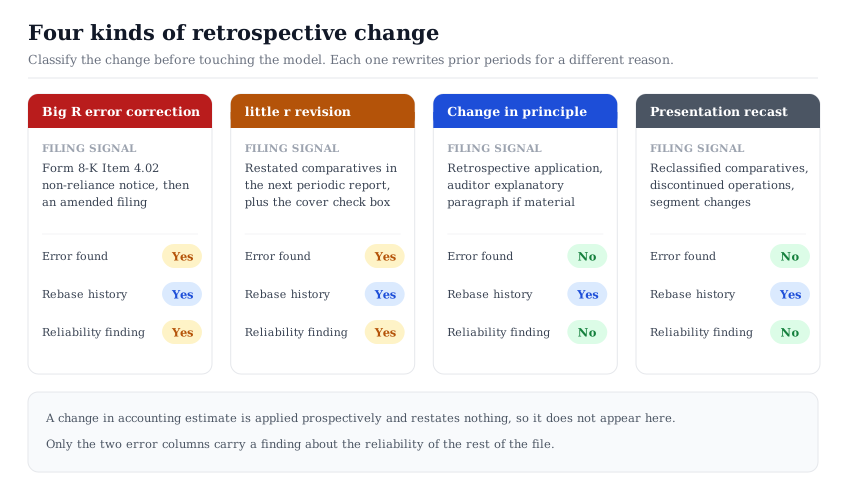
Several kinds of change rewrite prior periods, and they carry different information. A correction of an error means the earlier statements misstated something that existed when they were prepared. A change in accounting principle applied retrospectively means the earlier figures were acceptable under the old principle and are now presented on the new one. A reclassification moves amounts between captions without changing net income or equity, although subtotals such as operating income or operating cash flow can move. A change in accounting estimate rewrites nothing, because estimates are revised prospectively. An error immaterial to both the earlier and the current statements may also be booked as an out-of-period adjustment, leaving the comparatives as filed.
Only the first category tells you something new about the reliability of the rest of the file. The principle change and the reclassification are comparability events. They require the history to be rebased and carry no finding of misstatement.
What a restatement often leaves alone is cash. When a correction concerns the timing of revenue or expense recognition, it moves accruals between periods. The cash receipts stay where they were. The restated cash flow statement is therefore the first place to look, because it says how much of the correction reaches the inputs a cash flow model is built from.
This is a different question from which version a data source serves. Whether a database preserves original-as-reported figures or overwrites them is covered in how stock market database design determines reliability. The question here is what an analyst does with a model once the restated figures are in hand.
Four kinds of retrospective change and the filing signal for each
The Securities and Exchange Commission's Office of the Chief Accountant described the two error categories in a 2022 staff statement on assessing materiality. An error material to previously issued statements requires those statements to be restated, which the statement calls a reissuance or "Big R" restatement. An error immaterial to those statements may instead be corrected in the current comparatives. That route applies where either correcting it in the current period or leaving it uncorrected would be material to the current period. It is the revision, or "little r", restatement. Both are restatements to correct errors under US GAAP.
Each category leaves a different trace in the filings:
- Big R. A Form 8-K under Item 4.02, which the SEC added in its 2004 Form 8-K amendments. The company discloses the date of the non-reliance conclusion, the periods affected and a brief description of the facts. It also states whether the audit committee discussed the matter with the independent accountant. Corrected statements usually follow in an amended filing.
- Little r. No Item 4.02 filing and no amendment of prior filings. The correction appears in the comparative columns of the next periodic report, with a note describing the error.
- Change in accounting principle. Retrospective application recasts the prior periods presented. The auditor's report adds an explanatory paragraph when the effect is material.
- Presentation recast. Reclassifications, discontinued operations and segment changes recast the comparatives. Under PCAOB AS 2820, paragraph .11, a change in classification needs no mention in the auditor's report unless it also corrects a material misstatement or changes a principle.
The auditor's report is a second signal. AS 2820 paragraph .16 requires an explanatory paragraph when previously issued statements are restated to correct a material misstatement.
The third signal is newer. The SEC's 2022 compensation recovery rules added two check boxes to the annual report cover page. One indicates whether the statements reflect correction of an error to previously issued statements. The other indicates whether any correction was a restatement requiring a recovery analysis of executive incentive pay. Both are tagged in XBRL as DocumentFinStmtErrorCorrectionFlag and DocumentFinStmtRestatementRecoveryAnalysisFlag. The elements were first added in the SEC's 2022q4 cover-page taxonomy and are documented in the 2023 taxonomy release notes.
That first check box matters most for little r corrections, which carry no 8-K. It appears only on the annual report, so a revision first made in a 10-Q shows no flag until the 10-K. Finding the note itself is a matter of reading a 10-K section by section.
Financial restatement analysis: rebasing the history
Financial restatement analysis starts with replacing figures. Interpretation comes after. Every historical number the model uses gets swapped for the restated comparative, and every figure derived from those numbers is recomputed. Growth rates, margins, averages and the base year all go through the same pass.
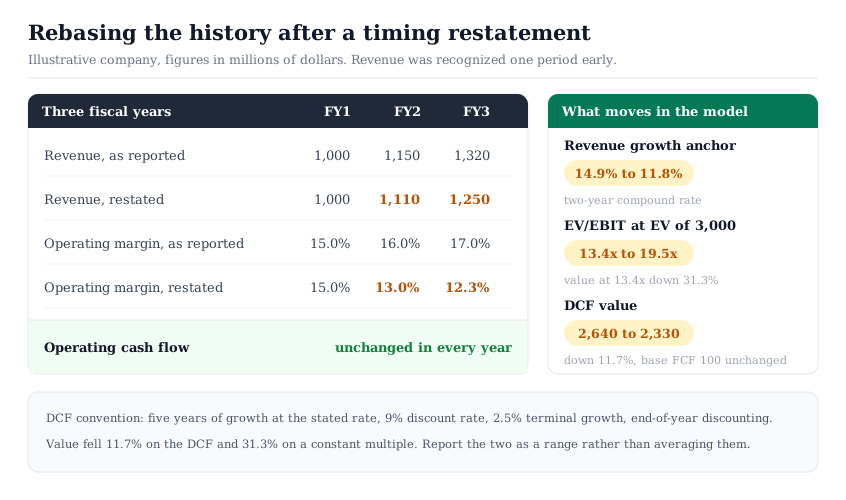
Take an illustrative company whose error recognized revenue one period early. As originally reported, revenue ran $1,000 million, $1,150 million and $1,320 million over three fiscal years. The restatement lowers the second year by $40 million and the third by $70 million, giving $1,000 million, $1,110 million and $1,250 million. The cumulative $110 million is not lost. It is recognized in later periods, when it was actually earned.
Assume the related costs were expensed as incurred, so operating income falls by the same amounts. Operating income was $150 million, $184 million and $224 million as reported, and it is $150 million, $144 million and $154 million restated. Operating margin in the third year falls from 17.0 percent to 12.3 percent. The reported history showed margins expanding by a point a year. The restated history shows them contracting.
Growth changes as well. The two-year compound revenue growth rate was 14.9 percent as reported and is 11.8 percent restated. An analyst who anchored a forecast on "about fifteen percent" was anchoring on a figure the company has withdrawn.
Operating cash flow is unchanged in every year, on the assumption that cash taxes and incentive pay were not recalculated. The customers paid on their contract terms, and recognizing revenue early moved receivables and deferred revenue without moving cash. The restated cash flow statement shows the same total with different reconciling lines.
That split is the reason to check cash before anything else. It is also where the data-source problem re-enters. A vendor that has not yet picked up the restated comparatives will keep serving the withdrawn figures, a propagation gap described in why fundamentals differ by source. Rebase from the filing itself, then check the data feed against it.
Which model inputs move, and which only appear to
Carry the illustrative company into two valuation methods and they move by very different amounts.
Start with the discounted cash flow. Base-year free cash flow is $100 million under both histories, because cash did not move. Grow it for five years at the historical revenue growth rate, discount at 9 percent, and apply a 2.5 percent terminal growth rate. The value is $2,640 million on the reported 14.9 percent anchor and $2,330 million on the restated 11.8 percent. The drop is 11.7 percent, and in this construction all of it comes from the growth path. The discount rate and the terminal growth rate have no reason to change. Holding the cash flow base and its margin constant is itself a choice, and the restated margin trend is a reason to revisit it.
Now the multiple. At an enterprise value of $3,000 million, EV to EBIT on third-year operating income was 13.4 times as reported. On the restated $154 million it is 19.5 times at an unchanged price. Read the other way, a value set at a constant 13.4 times falls by 31.3 percent, the full size of the earnings correction.
On the same restatement, value from the discounted cash flow fell 11.7 percent and value from the constant multiple fell 31.3 percent. Averaging them would hide exactly what the restatement revealed: the earnings history overstated profitability, and the cash history did not. Report the two results side by side and name the input that separates them. The general case for keeping divergent methods apart is made in why valuation methods disagree.
Two cautions keep this from becoming a rule of thumb. First, some restatements do move cash, or the classification of cash. A correction that shifts an outflow from investing to operating activities lowers operating cash flow. Free cash flow, measured as operating cash flow less capital expenditure, is unchanged if the outflow had been reported as capital expenditure, as with costs wrongly capitalized. If it had sat elsewhere in investing activities, free cash flow falls by the full amount. Any input anchored on operating cash flow or on capital intensity changes in both cases. Second, the growth anchor is a choice. An analyst who never used the three-year history as a guide has less to change. What the restatement forces is a check of every input for whether it was derived from the withdrawn figures.
A trailing figure deserves the same check. A trailing-twelve-month total built from quarters that straddle the restated periods mixes two bases, a trap set out in trailing twelve months versus fiscal year.
Reliability as an input: what an error correction says
A change in principle or a recast carries no finding of misstatement. An error correction does. It establishes that the earlier statements were misstated when issued. The error may have been missed, known and judged immaterial, or the product of a reading of GAAP later found wrong.
The SEC staff statement connects errors to controls directly. The identification of an error feeds management's assessment of internal control over financial reporting. A material error is an indicator of a material weakness, although a weakness can exist without one. So the second place to look after the restatement note is the controls section of the same annual report, and the auditor's opinion on internal control where one is required.
The same statement, citing third-party restatement data, reports that total restatements declined each year from 2013 to 2020. The little r share of the total rose to nearly 76 percent in 2020, from about 35 percent in 2005. Some attribute the shift to better controls and audit quality. The staff added that some materiality analyses appeared biased toward concluding an error was immaterial, which produces the revision route. A little r correction can therefore carry more information than its quiet presentation suggests. Read the note for the size of the error relative to the affected line, not just its label.
The finding belongs in the width of the valuation range. It does not belong in the discount rate. A cost of capital prices the market risk of the cash flows. Doubt about the reported history is doubt about the inputs. A rate premium applies that doubt as a haircut that compounds with every forecast year. A wider range, or a larger required gap between price and value, expresses the same doubt without distorting the model. That gap is the margin of safety set as an operational rule, and a restatement is an event that justifies widening it on evidence.
The pattern over time matters more than any single correction. One immaterial revision in a decade is a different finding from three corrections in four years touching the same revenue line. The earnings quality red flags that test whether reported profit is backed by cash are the natural companion check.
A restatement log: what to record
The work fits in one entry per restatement, and it is short enough to keep.
- Type and signal. Record the category (Big R, little r, change in principle or recast) and the document that established it. That may be an Item 4.02 8-K, the restatement note, the auditor's explanatory paragraph or the cover-page check box.
- Periods and lines. List which fiscal periods were rewritten and which line items changed, with the before and after figures for each.
- Cash test. Compare total operating cash flow and capital expenditure before and after. State whether cash moved or only accruals and classification.
- Inputs changed. Name each model input derived from the rewritten figures and its old and new value. In the illustrative case, that is the growth anchor.
- Reliability finding. For error corrections only, note the size of the error relative to the affected line and any disclosed material weakness. Record how the valuation range changed as a result.
The discipline is the same one that governs a valuation tracker for every stock you own: the entry explains why a number moved, so it can be defended later. A broader verification pass across all fundamentals sits in the fundamental analysis checklist.
Where this sits in the workflow
Restatement handling belongs to verification rather than modeling, and it recurs. Every new filing is a check on whether the history under the model still stands. The trigger is the filing itself.
The InvestViable Valuator takes a cash flow growth path, a discount rate and a terminal growth rate. In the illustrative case only the first of those needed to change, and only because it had been anchored on revenue the company later restated. The same test runs on every input before the model is rerun. Screens need the same care. The InvestViable stock screener works on reported fundamentals across US equities, and the Stock Universe pages such as value stocks cover slices of that same universe. A threshold set on margin or growth inherits whichever version of the history the underlying data carries.
For the platform side of the same problem, the cross-platform data-source audit covers how to tell which restatement layer a figure comes from. What this piece adds is the model side. Classify, rebase, test cash, change only what was derived from the withdrawn figures, and write down the reliability finding next to the valuation.
InvestViable does not publish buy or sell recommendations on individual securities. All analysis is based on public financial data and a transparent methodology. The Investment Score formula is proprietary; the inputs and what the score evaluates are documented.